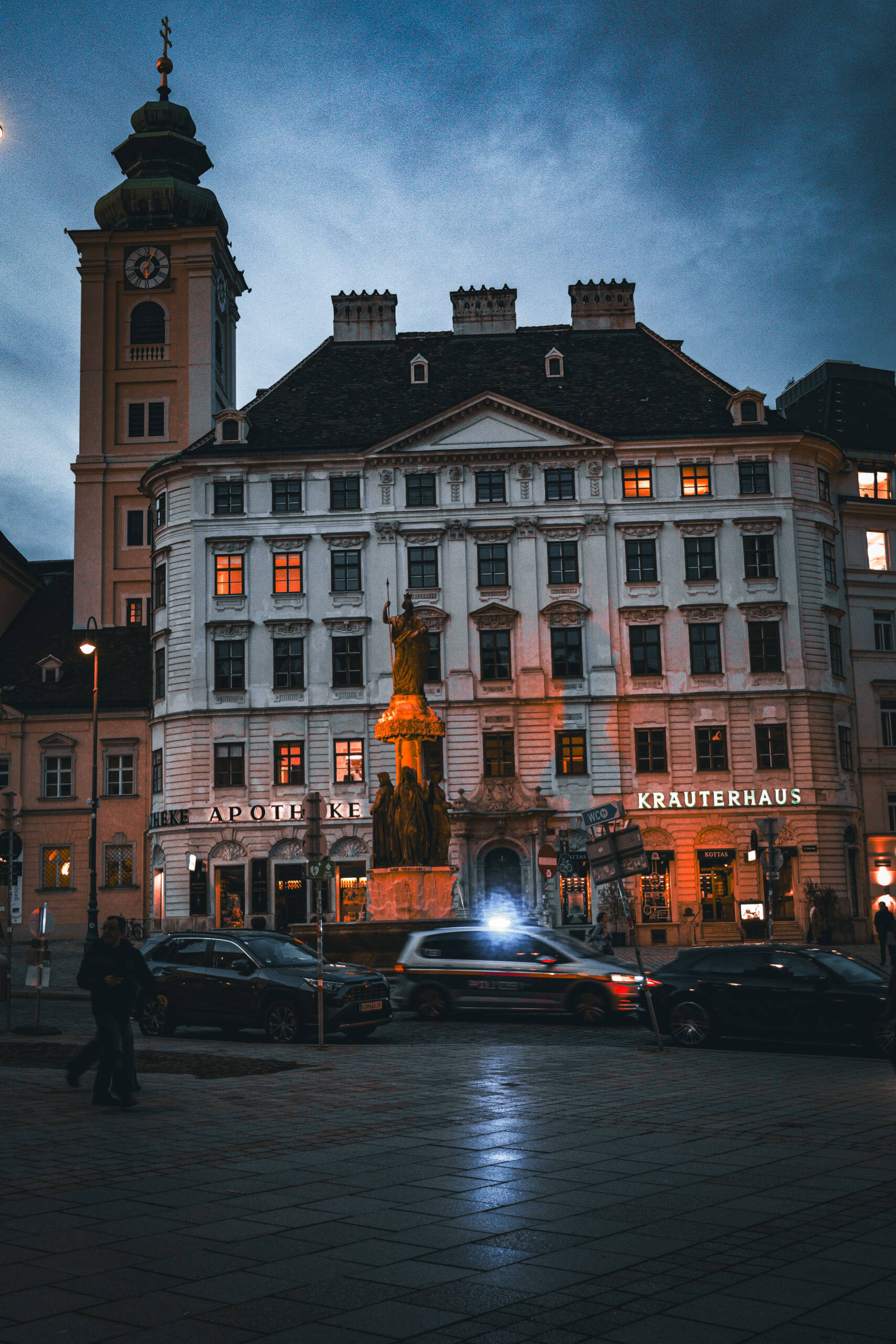
A color grade that works on one image is a lucky accident. A color grade that works across a full shoot in mixed light is a system. Building systems is the actual craft, and you start to see why the moment you look at a scene where everything is working against you at once—deep blue twilight sky, warm artificial lighting spilling from windows, and moving subjects cutting through both. In the frame here, a historic European square sits under a heavy evening sky, the kind that leans toward cyan and desaturation, while the building itself glows from within—windows lit in rich amber, storefronts radiating warmer tones, and a statue in the center catching a mix of sodium-like street lighting and residual daylight. Even the passing cars streak through with cool white highlights and reflections, briefly interrupting the balance. This is exactly the kind of situation where most presets collapse.
The foundational principle is separating luminosity decisions from color decisions. In a scene like this, the eye wants to fix everything at once—the sky feels too heavy, the building too warm, the street too dark—but that instinct leads to fragile results. If you bring the image to a stable exposure and contrast baseline first, you suddenly create structure: the sky holds its texture without turning muddy, the building façade retains detail in both shadow and highlight, and the glowing windows sit where they should, as accents rather than blown distractions. Only after that does color begin to make sense. The mistake is thinking color can solve structural problems. It can’t, and here it would only exaggerate the tension between the cold ambient light and the warm artificial sources.
White balance becomes the quiet saboteur in mixed conditions like this. There is no correct answer globally—if you neutralize the sky, the building turns overly warm; if you correct the building, the sky becomes unnaturally cold. The workable approach is normalization, not perfection. You aim for a baseline where neither element feels extreme, accepting that both will carry some of their natural bias. In this image, that means letting the sky stay slightly cool while pulling back just enough warmth from the building to prevent it from dominating. The goal is cohesion, not neutrality. You are essentially creating a controlled compromise that the grade can sit on top of.
HSL selective color is where the system starts to show its strength. Look at how the warm tones behave here—the orange windows, the lit signage, the subtle warmth on the statue. If those drift too far, the entire image feels artificial. If they are too muted, the scene loses its emotional anchor. Targeting the orange and yellow ranges allows you to shape that warmth precisely without contaminating the cooler tones of the sky and pavement. At the same time, subtle adjustments in the blue and cyan channels can deepen the sky without crushing it into a flat block. The separation of these color zones is what keeps the image stable across conditions, because each range is being managed intentionally rather than globally.
What stands out, looking at this frame a bit longer, is how much restraint matters. The grade does not try to unify everything into a single mood by force. The coolness of the sky is allowed to exist alongside the warmth of human activity—the lit windows, the street-level shops, even the faint glow reflecting off the wet pavement. The motion blur of the passing car adds another layer, a brief streak of brightness that could easily blow out if the grade were too aggressive. Instead, it sits inside the exposure, controlled but alive. That’s the difference between a grade that survives and one that breaks: it respects the original relationships in the light.
The grade that holds is the one with the fewest assumptions baked into it. Scenes like this make that obvious, because they refuse to conform. Build on neutral ground, move in a direction rather than forcing an endpoint, and leave room for the light you did not control. When you do, even a complicated mix of dusk, artificial light, and motion starts to feel coherent—almost effortless, though it never really is.