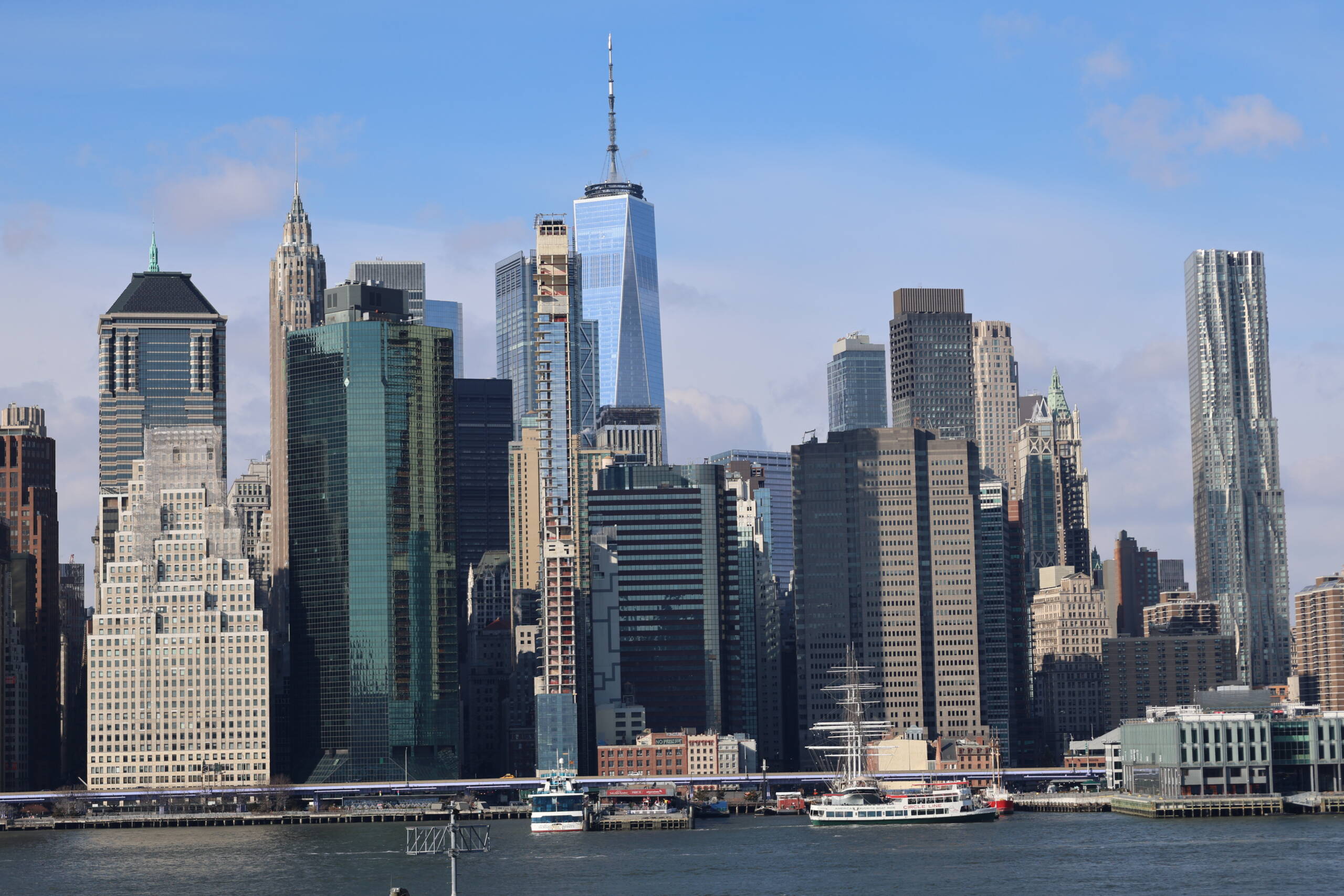
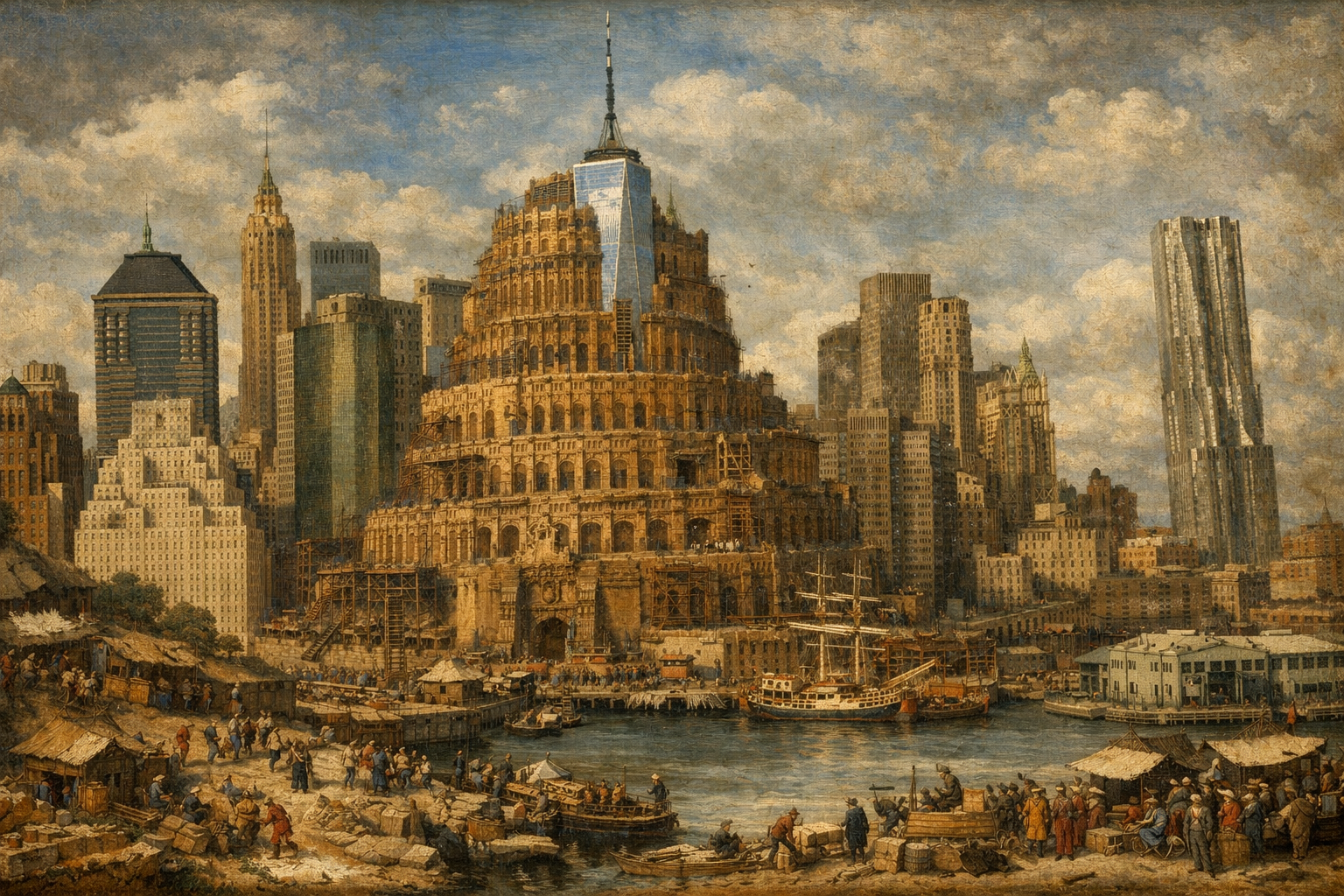
This large-scale painting stages a collision between epochs, placing a contemporary metropolis inside the visual logic of a myth that never really left us. At the center rises a colossal, unfinished tower, spiraling upward with a confidence that feels both triumphant and precarious. Its structure borrows the circular, terraced mass of Bruegel’s Tower of Babel, yet its crown pierces the sky with glass, steel, and a needle-like spire unmistakably drawn from the language of modern skyscrapers. Around it, familiar urban silhouettes cluster tightly together, their facades compressed into a dense architectural chorus, as if the city itself has been pulled inward by the tower’s gravitational ambition. The river in the foreground acts as both stage and witness: boats glide past scaffolding, workers haul stone and timber, and small human figures repeat gestures of labor that feel timeless, almost ritualistic. The palette leans toward warm ochres, muted blues, and weathered greys, giving the entire scene a patina of age, as though this future city has already become an artifact. Nothing here feels frozen; the air is busy, slightly hazy, full of motion and intent, and yet the sky above remains oddly indifferent, expansive, and calm. The painting reads as a quiet but pointed meditation on progress, scale, and human ambition, suggesting that every era rebuilds the same tower with new materials and new names, convinced, once again, that this time it might finally reach the heavens.
The Second Workshop of Babel
The concept begins as a deliberately anachronistic studio, one that treats history, myth, and scripture not as static references but as living visual material. At its core sits an AI image engine trained to remix modern cityscapes, technologies, and social rituals with biblical narratives, ancient epics, and pivotal historical moments. Think of contemporary skylines folded into Genesis scenes, financial districts recast as medieval marketplaces, or modern infrastructure threaded through stories of exile, flood, revelation, and empire. The AI is not positioned as the final author but as a generator of dense visual propositions, rough yet evocative paintings that carry symbolic tension and narrative ambiguity. These digital works function like modern sketches or cartoons once did for Renaissance workshops: starting points charged with ideas, mood, and composition rather than finished objects.
From there, the model deliberately slows down. Selected AI-generated works are handed to ghost artists, trained painters operating anonymously under the umbrella of the studio. Their role is not to replicate pixel for pixel, but to interpret, correct, exaggerate, and humanize the image through physical paint. Brushwork, material resistance, small imperfections, and personal intuition re-enter the process at this stage. Each painting becomes a translation rather than a copy, subtly different from the AI source and from other versions derived from the same prompt. The anonymity of the artists is not a limitation but a conceptual choice, echoing medieval workshops where authorship was collective and the work itself carried the meaning. What matters is continuity of vision rather than signature.
The gallery completes the circuit by functioning as both exhibition space and narrative environment. It is not presented as a traditional white cube, but as a contemporary atelier where process is partially visible and myth-making feels ongoing. Digital previews of the AI originals may be shown alongside finished paintings, not as a gimmick, but as a quiet acknowledgment of layered authorship. The works are sold as physical objects with documented provenance: AI concept, human interpretation, material execution. Collectors are invited not just to buy a painting, but to acquire a fragment of a larger system that reflects how images, beliefs, and power circulate today.
Commercially, the model scales in two directions at once. Digitally, the AI can continuously generate new thematic series tied to current events, urban transformations, or cultural anxieties, keeping the concept relevant and reactive. Physically, production remains limited and controlled, preserving scarcity and craft value. The tension between infinite digital possibility and finite painted output becomes part of the brand’s appeal. Over time, the gallery positions itself less as a place that sells paintings and more as a contemporary myth factory, one that understands that in every era people want to see their present reflected inside older stories, if only to reassure themselves that ambition, confusion, and faith have always looked something like this.
Leave a Reply