• Skip to main content
  • Skip to secondary menu
  • Skip to footer

Pixel Effects

Pixel effects. Media gallery. Visual storytelling.

  • Sponsored Post
  • About
    • GDPR
  • Calendar
  • Domain Aftermarket
  • Contact

From Documentation to Atmosphere: Why Painterly Images Belong in Modern Media

February 26, 2026 By admin Leave a Comment

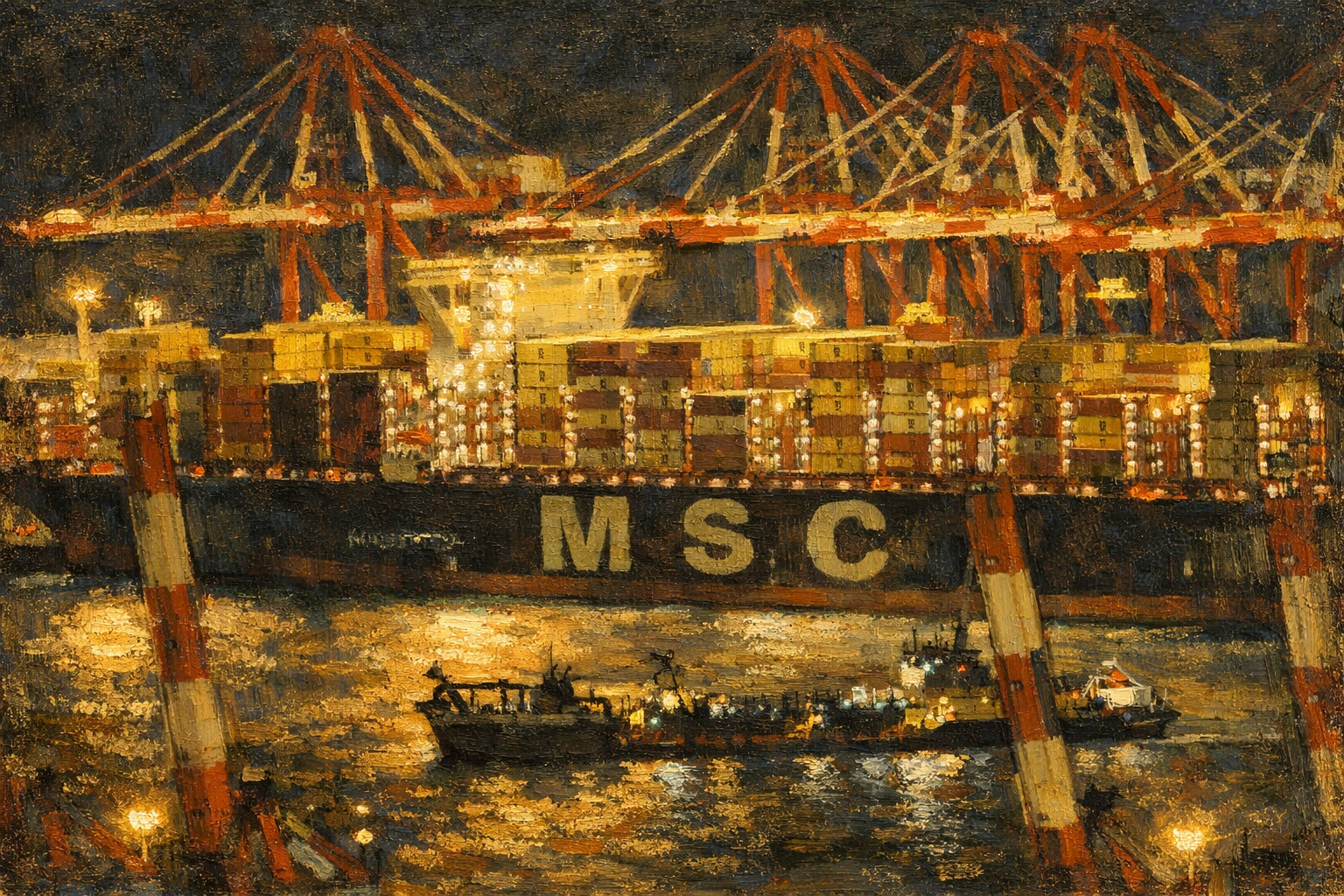
This image begins life as something almost brutally factual: a massive MSC container ship at night, cranes stretched like skeletal ribs against a dark sky, containers stacked into rigid grids, work lights glittering across black water. In its oil-painting transformation, though, the scene loosens its grip on pure documentation. Brushstrokes soften the geometry, lights bleed into golds and ambers, reflections tremble instead of mirror, and the whole port feels less like infrastructure and more like a living organism that never really sleeps. You still recognize the ship, the scale, the industry, but the image no longer asks you to count containers or identify a terminal. It asks you to feel the weight of global movement, the hum of trade, the quiet tension between human engineering and night.
From Documentation to Atmosphere: Why Painterly Images Belong in Modern Media

This is exactly where painterly images become powerful tools in media. In news, analysis, or long-form storytelling, literal photography can sometimes be too precise, almost too complete. It tells you what happened, where, and when, but it often shuts down interpretation. An image like this, rendered in an impressionistic oil style, opens space instead of closing it. It works especially well in stories about systems rather than events: global supply chains, maritime logistics, energy flows, trade disruptions, or economic pressure points. The softened edges and expressive texture signal that the story is not about one ship on one night, but about something larger, slower, and harder to pin down. Readers linger longer, not because the image explains more, but because it explains less in a more suggestive way.
Why Painterly Images Belong in Modern Media

In editorial and analytical media, these images act almost like visual metaphors. The glowing cranes become symbols of constant labor, the shimmering water hints at fragility beneath apparent strength, and the blurred motion of smaller vessels suggests the human scale moving under colossal structures. When paired with text about market volatility, geopolitical tension, or industrial transformation, such imagery reinforces tone without competing for factual authority. It does not argue with the data; it frames the mood in which the data should be read. That’s a subtle but crucial distinction, especially for platforms that want to feel thoughtful rather than sensational.

There’s also a practical advantage. Painterly images age better. A straight photograph of a specific ship, terminal, or moment can feel outdated quickly once circumstances change. An impressionistic rendering resists that decay. It becomes illustrative rather than archival, reusable across articles, newsletters, and background explainers without feeling recycled. For digital publications, this matters. Visual continuity builds identity, and a consistent use of stylized imagery can quietly signal editorial voice: reflective, analytical, human-scaled, not just reactive.

Used carefully, images like this don’t replace photography; they complement it. Raw photos anchor reality. Painterly interpretations translate that reality into atmosphere and meaning. In a media landscape saturated with sharp, instant visuals, choosing an image that slows the eye and invites interpretation can be a strategic decision, not an aesthetic indulgence. Sometimes the most effective way to show how the world works is not to show it exactly as it looks, but as it feels when you step back and really think about it.

Filed Under: Blog

Reader Interactions

Leave a Reply Cancel reply

Your email address will not be published. Required fields are marked *

Footer

Recent Posts

  • Turning AI Drafts into Real Work: Canva Expands Deep Integration with Anthropic’s Claude Design
  • Adobe Introduces Firefly AI Assistant, Turning Creative Workflows into Conversations
  • What the Sunglasses Saw
  • What Photoshop’s Generative Fill Gets Right and Wrong
  • The Art of the Subtle Edit: When Less Processing Wins
  • How ControlNet Changed AI Image Generation
  • Capture One vs Lightroom: The Real Differences in 2026
  • Why Your AI-Generated Images Look Like AI-Generated Images
  • How to Add Film Grain That Doesn’t Look Digital
  • Luminosity Masking Without the Mysticism

Media Partners

  • Referently.com
  • Briefly.net
  • ESN.net
Sponsored Post
About
Contact
The Forward Deployed Engineer Is the AI Industry's Admission That Models Don't Ship Themselves
The CNN Fear & Greed Index: How to Read It, What It Measures, and Where It Fails
VIX Explained: What the Fear Gauge Actually Measures, How to Read It, and Why It Mean-Reverts
Bitdefender 2026 Global Scam Intelligence Report: One in Seven Consumers Victimized, Finance Fraud Dominates Every Channel
Marvell's Moat Is Connectivity, Not Custom Silicon
60 GHz WiGig Is Not Dead: Here Is Where It Actually Makes Sense
802.11r, 802.11k, 802.11v: The Three Protocols That Make WiFi Roaming Seamless
Balerion AI Raises $6 Million to Bring Agentic AI to Mortgage Origination
Live Nation and Ticketmaster Lose the Core Antitrust Fight
Why Prestige Drama Keeps Collapsing in Season Three
The Newsletter Bubble and Who Survives It
Peak TV Is Over — What Comes Next
Why Startup Valuations Haven’t Fully Reset
What the Fed’s Patience Is Actually Signaling
Dollar Dominance: Slow Erosion or Cliff Edge?
The Cloudflare CMS Bet and What It Signals
Why AI Products Keep Looking the Same
The $931 Million Insider Signal the Quantum Bubble Can No Longer Hide
TechSummit.net
Why We Love Orchids
Turning Attention Into Opportunity
Arearea (Joyeusetés), 1892 — Gauguin’s dream of Tahiti as a constructed paradise
Une rue à Paris en mai 1871 — Luce’s memory of a city after rupture
Jean-Léon Gérôme, The Gladiators and the Modern Gaze on Rome, Musée d’Orsay, Paris
Garamendi Blasts Trump’s FY27 Budget as a War Budget Disguised as Fiscal Policy
The Sports Rights Bubble and Where It Breaks
India’s Moment and Why It Keeps Getting Delayed

Media Partners

  • ZGM.org
  • JVQ.net: Just Very Quick
  • k4i.com
Together AI Raises $800M Series C at $8.3B Valuation to Scale Open Source Inference
Technology, Finance, and Smart City Events: Selected Global Calendar, 2026
Two Signals, One Crisis
House Democrats Urge Mike Johnson to Restore Bipartisan Smithsonian Women’s History Museum Bill
Borders, Memory, and the Future of European Identity
Canon R100 Field Notes: Budget Gear, Real Results
Video Rebirth Secures $80 Million to Industrialize AI Video and Build the Next Layer of Digital Reality
A Brief History of Tea: From Ancient Leaves to a Global Ritual
Photography Workshop by Pho.tography.org — Spring Session
S3H.com Announces Groundbreaking Web Dev Service Launch
New-Tech Exhibition 2026, 30.06-01.07.2026, Tel Aviv
Valerian for Stress: Weak Evidence, Mild Risk, Oversold Promise
AI’s Next Market Shockwave Is Coming: AMD, Broadcom, and NVIDIA Earnings Are Around the Corner
Quantum Computing’s $931 Million Insider Sell-Off Is the Bubble Warning Wall Street Can’t Ignore
Quantum Stocks Are Starting to Look Like the Next Meme Stock Bubble
Danielle Deadwyler and the Problem of Being the Best Thing in Every Room
EDC Las Vegas 2026: What Attendees Need to Know Before the Weekend
Did Sean Strickland Win?
The Crawford-Mayweather Debate Is a Question Boxing Cannot Answer
2026 Is the New 2016. TikTok Said So and Now It's Everywhere.
KOSPI Falls Despite Samsung's Record Quarter: A Sell-The-News Story
Market Roundup: Broadcom-Apple Extends, Meta's Compute Dilemma, And 0DTE Options Hit A Record
Samsung Q2 2026: Operating Profit Up 19x, Yet The Stock Sold Off
Saylor's Strategy Sells $216M In Bitcoin, Testing Its New Monetization Program
SK Hynix's $28B Nasdaq Listing Draws Leopold Aschenbrenner's Hedge Fund
SpaceX Joins The Nasdaq 100: Why $800B In Index Funds Have To Buy Now
TeraWulf's $19B Anthropic Lease Turns A Bitcoin Miner Into An AI Landlord
Cerebras Has a Real Moat and a Real Problem: Great Silicon, a Two-Customer Revenue Base
Kioxia and SanDisk's 332-Layer Milestone: A Real Technology Lead, Priced Into a Cyclical Business With No DRAM Cushion
Memory Stocks Just Had Their Worst Week Since April 2025 — Seven Forces Behind the Selloff

Copyright © 2022 PXEF.com