From a distance, the city looks almost dreamlike, softened by the shallow depth of field into a sea of pale stone buildings, red-tiled roofs, scattered trees and layers of urban life stretching toward the horizon. But in the foreground, the picture tells a very different story: this is not simply a view of a city, it is a view of the people who are documenting it.
Two media professionals stand at a railing overlooking the densely built landscape, their backs to the camera. One is working with a still camera, carefully framing a shot, while the other appears to be preparing for a television or video report. Between them stands a professional Sony video camera mounted on a tripod, complete with an external monitor, microphone and other production equipment. The setup immediately suggests a news crew or documentary team working from an elevated position, using the city below as both subject and context.
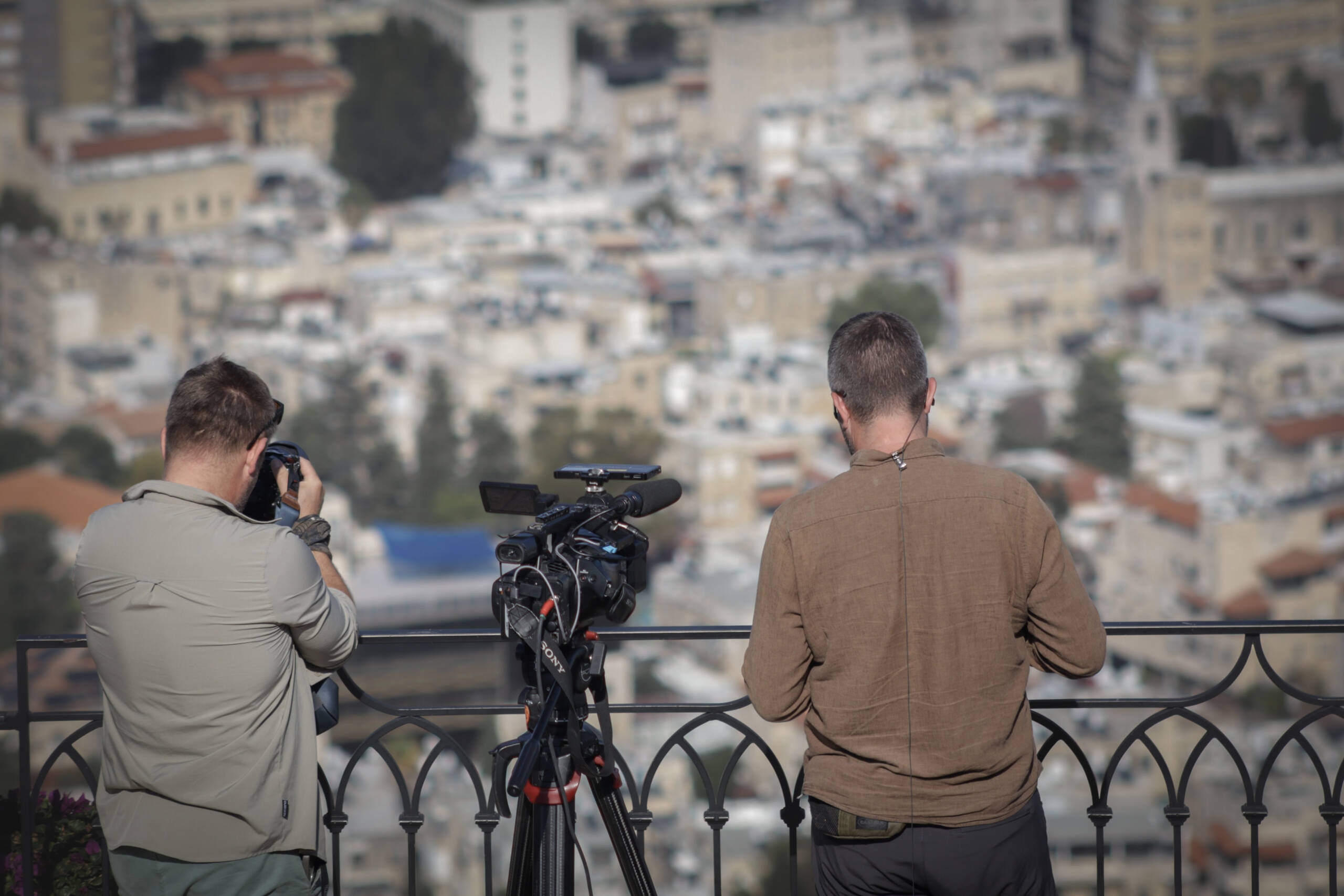
There is something particularly interesting about photographing journalists from behind. We don’t see their faces, so the focus shifts away from who they are and toward what they are doing. Their attention is directed entirely toward the city. One photographer is actively looking through the viewfinder, while the other appears to be watching the scene or preparing for his next shot. The cables, microphone and broadcast camera add a sense of working reality; this is the less glamorous side of media production, where getting the right image often means standing for a long time in the same place, carrying heavy equipment and waiting for the right moment.
The railing creates a strong horizontal division between the working media team and the city beyond them. Meanwhile, the blurred background gives the image a cinematic quality, turning thousands of individual buildings and streets into an abstract urban texture. The contrast is effective: the foreground is sharply defined and highly technical, while the enormous city behind it is deliberately indistinct.
For Media Forum, the photograph can be read as a simple visual metaphor for journalism itself. The audience sees the finished photograph, video report or news story, but rarely sees the people standing behind the cameras who made it possible. Before a story reaches a website, television screen or social media feed, there is usually someone standing somewhere like this, looking through a lens, checking a monitor and trying to make sense of a complicated world.
And perhaps that is the most compelling part of the image. The city may be the story, but the people with the cameras are the ones who decide how the story will be seen.
MediaForum.net:
- Tech Digest: Google's £1.2B Play Store Case, Toshiba's AI Hard Drive Push, Gemini's Free Tier Cut and Valley's $340M Bluevine Deal
- Four Nights in Europe: What Mixed Artificial Light Does to a Photograph
- Brussels Social Housing Standoff: MR Freezes €131 Million Over Foyer Anderlechtois Chairman
- Syracuse Has No Town Beach, So Ortigia Swims Off the Rocks
- Weekly Network Analytics Summary: August 30 to September 5, 2026
- SanDisk (SNDK) Rallied 11.9% Into an S&P 100 Add That Forces Almost Nobody to Buy
- Texas A&M Is Spending $11.8 Million on a Water Tower Before Its Semiconductor Institute Can Open
- Three European Cities Where Architecture and Festival Collide
- Pedro Sánchez Lost Control at Ceuta and Blamed Everyone Else
- Cloudflare's September 15 AI Crawler Block Turns the Ad Tag Into an Access Key
Referently.com:
- Credit Rating Scales Compared: S&P, Moody's and Fitch Equivalents, Investment Grade Cutoff and Default Rates
- US Chip Export Controls Timeline: Every Major BIS Rule on China Since 2022
- Undersea Cable Damage Log: Baltic Sea, Taiwan, Red Sea and Australia Incidents Since 2023
- Export Control and Sanctions Acronyms Explained: EAR, ECCN, FDPR, SDN, Entity List and More
- Chip Node Names Decoded: What 3nm, 2nm, Intel 18A and TSMC A16 Actually Mean
- China's Critical Mineral Export Controls: Gallium, Germanium, Antimony, Graphite and Rare Earths Timeline
- Backcasting Explained: How Planning Backwards From a Future Goal Works
- AI Compute Thresholds Compared: How the EU, California, New York, Illinois and South Korea Define Frontier Models
- Book Ciphers and Running-Key Ciphers: Why a Text-Based Key Fails Today
- The Broken Noses on Egyptian Statues Were Not an Accident