The photograph lives in that uneasy space between documentation and observation, where nothing is staged yet everything feels composed by chance and timing. The scene unfolds inside a trade show hall, but it doesn’t scream branding or slogans; instead, it hums quietly with movement. People drift through the frame in overlapping layers, half-turned bodies, hands mid-gesture, faces caught between curiosity and distraction. On the right, a tall, curved interactive screen glows with a cold, precise light, reflecting fingertips and fragments of faces, its surface acting almost like a mirror that slightly lies. A young woman reaches toward it, her hand hovering, not fully committed yet, while a man beside her looks away, distracted by something beyond the frame, which somehow makes the moment feel more real. Behind them, a massive digital backdrop fills the wall with classical arches and fresco-like colors, architectural imagery that evokes travel, history, and grandeur, yet feels oddly detached from the temporary, carpeted reality of the hall below. That contrast, ancient imagery floating above a modern crowd wearing lanyards and jackets, is where the photograph quietly settles.
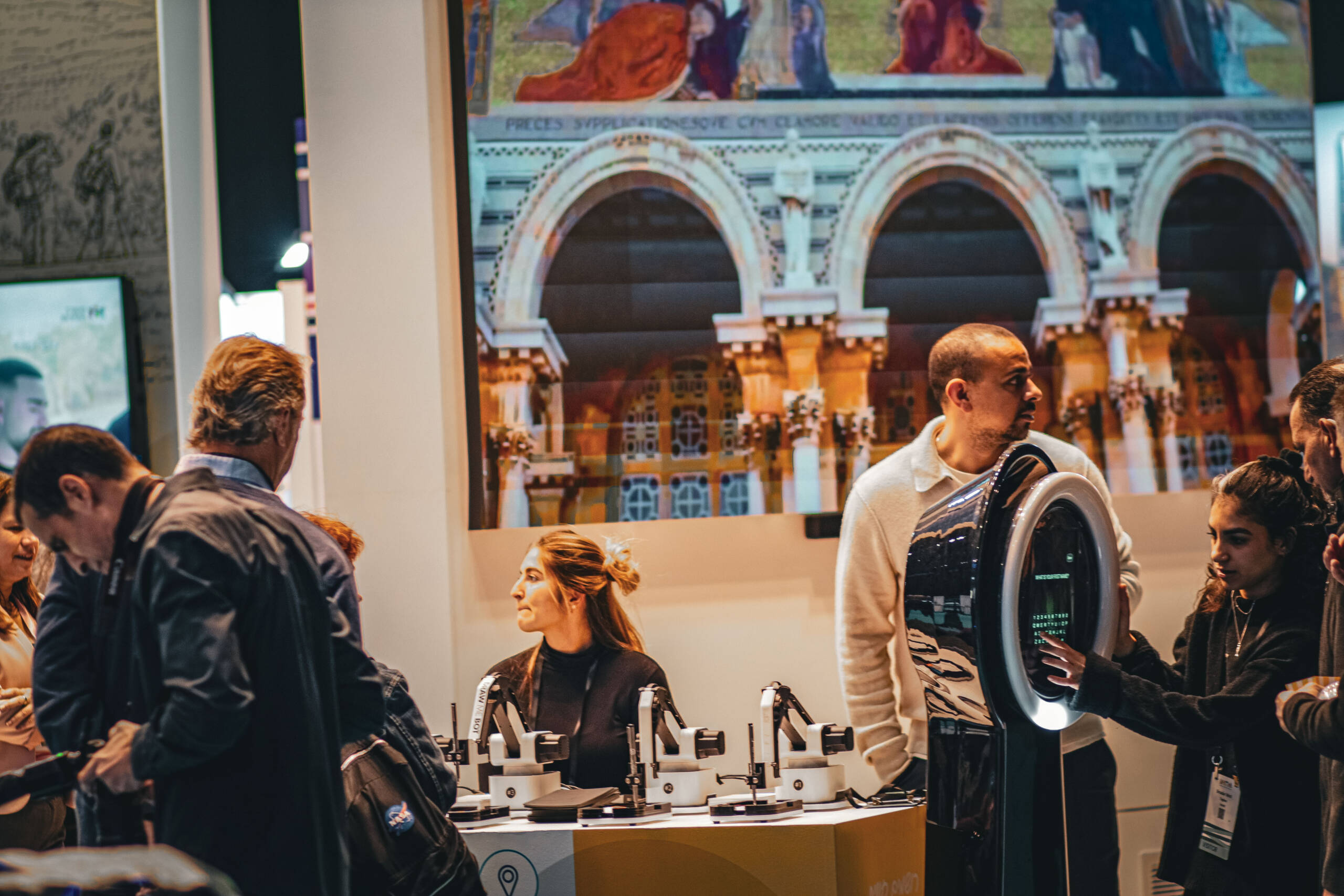
What makes this image interesting for a photoblog isn’t the subject itself, but the way light behaves across the scene. Artificial illumination spills from multiple sources, overhead exhibition lighting, the glow of screens, reflections off polished surfaces, creating a layered palette of warm and cool tones that never fully agree with each other. Skin tones shift slightly depending on where people stand, faces closest to the screen picking up a bluish cast, others warmed by ambient light bouncing off white panels and signage. Depth is created not through shallow focus tricks, but through human density, figures overlapping naturally, some sharply defined, others softened by motion or angle. The background isn’t meant to be background at all; it’s loud, colorful, and symbolic, yet the eye keeps returning to the human interactions in the foreground, the seated woman behind the counter glancing sideways, the identical devices lined up with almost military neatness, the casual intimacy of strangers sharing a temporary space.
Photographically, the frame works because it embraces visual noise instead of fighting it. Trade shows are chaotic by nature, and trying to simplify them too much often strips away their truth. Here, the composition allows clutter to exist while still guiding the viewer’s attention through subtle cues, the curve of the screen, the horizontal line of the counter, the arches echoed above. It’s a reminder that street photography principles apply just as well indoors: patience, awareness of body language, and a willingness to accept imperfect moments. No one poses, no one performs for the camera, and that’s exactly why the image holds. It documents a modern ritual of professional life, people gathering not in streets or cafés, but in branded halls filled with light, technology, and fleeting conversations, all of it temporary, all of it strangely human.
Related
- Tech Events Are About People Too
- My Experience with Samsung’s AI Home at IFA 2025
- Quiz: Spot the Photographer at the Open-Air Conference
- Chinatown, New York: A Photowalk Where the Street Shoots Back
- CP+ Camera & Photo Imaging Show 2026, February 26–March 1, Yokohama
- How I Covered Cybertech 2026 with a Canon R8, One Wide Lens, One Long Lens, and a Lot of Walking
- Imaging USA, January 11–13, Nashville, Tennessee
- How to Shoot Informal Tech Events (Without Making Them Look Like Events)
- A Lens That Hunts for Stories
- Microseries Photography: Small Stories, Quiet Worlds
- PPA Launches PhotoVision, a Streaming Hub for the Global Photography Community
- The Frugal Photographer’s Manifesto
- When Military Eyes Meet the Photographer’s Imagination
- Street Photography by the Sea with a 100mm Lens
- The Blurred Line Between Real and Artificial: Why AI Photos Confuse Consumers
Leave a Reply