A naked woman stands in a heap of wreckage, one knee braced against a felled tree, three eagles working the air around her. Behind her the sky is filled edge to edge with office blocks, drawn flat and repetitive, the windows scratched in like graph paper. Two construction cranes sit in the gaps. There is no horizon. That is the whole of the picture, and it is signed HARBURGER, 1977.
The woman is Nature. This is an old device and Francis Harburger uses it without apology: the human body as the thing being torn at, painted with real anatomical care while everything behind her is deliberately schematic. She isn’t posed heroically. Her hand is up behind her head, her weight is uneven, and she’s looking down at the birds rather than out at us. She looks like someone who has just been woken up.
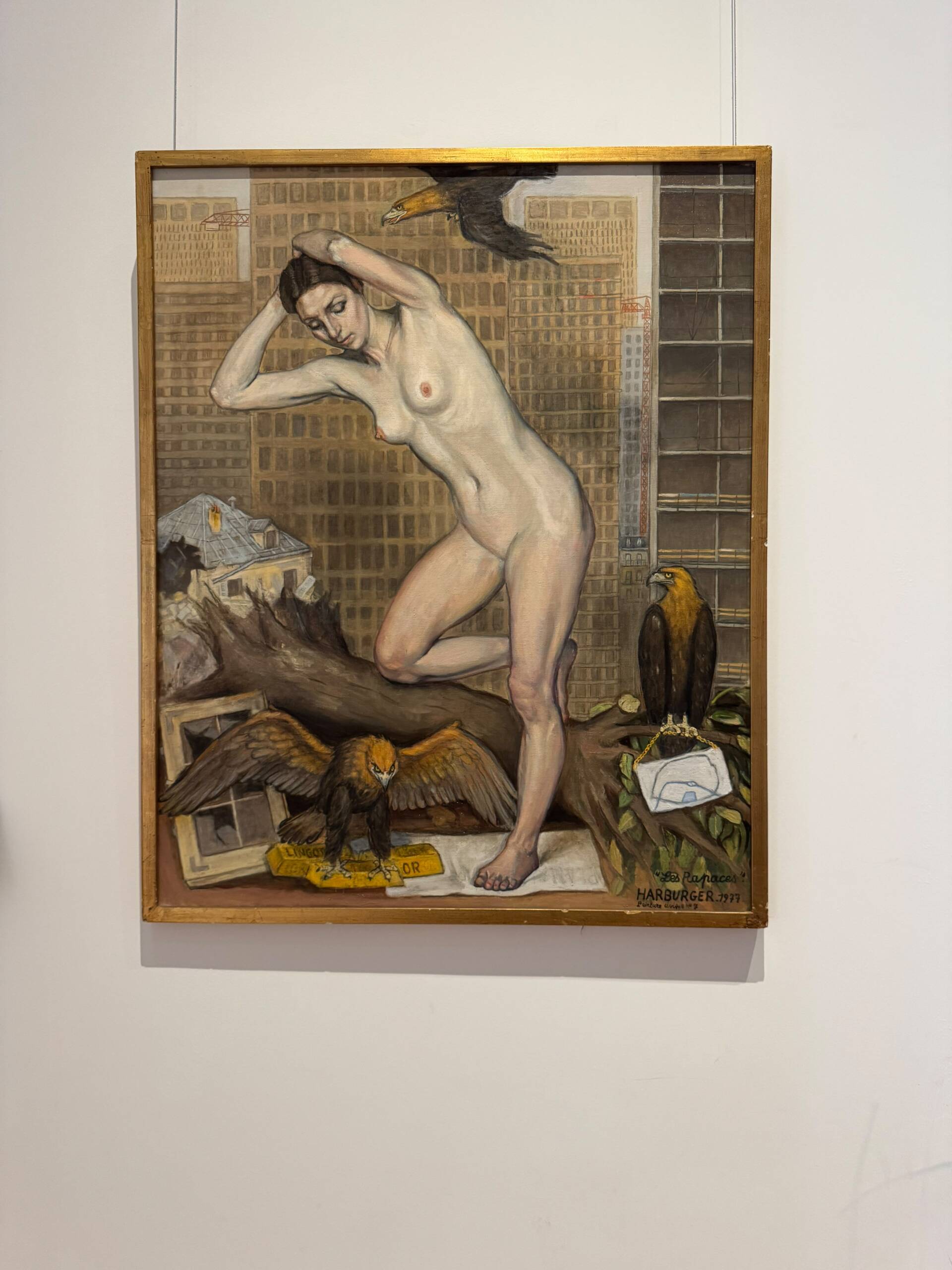
Look at what she is standing on. Bottom left, a townhouse with its roof caved in and its flank ripped open, the kind of small Parisian building that came down in the thousands in that decade. Beside it, window frames stacked like salvage. Under her right foot, a white sheet of paper. And the ingot: a yellow bar stamped in block letters with the word OR, pinned under the claws of the second eagle, which has its wings spread wide over it like a bird mantling a kill.
The third bird, perched on the right, is standing on a white rectangle with a blue line drawn across it. That is a plan of Paris, and the district picked out in blue is the 14th. Harburger lived there. The joke, if it is one, is entirely private and entirely legible: the bird has its foot on his own street.
Two titles, one argument
The painting goes by two names. Les Rapaces is the one written on the canvas in quotation marks, next to the signature. The other is Défense écologique, and it places the work inside a series Harburger had been building since around 1949, which he called his civic compositions. The idea behind that series was that painting could argue. Not illustrate an argument, argue one, the way a poster or a pamphlet does, except slowly and in oil.
The earlier entries in the sequence took on racism, European unity, the money side of the art trade. This one takes on the demolition of a city. The two titles do different work. Défense écologique is the case being made. Les Rapaces is the accusation, and it is not aimed at concrete or at modernity in the abstract. Birds of prey are not weather. Somebody is holding the gold bar.
The date matters more than it looks
1977 is not a random year to paint this in.
By then the worst of it was already done. The Halles pavilions had been pulled down at the start of the decade and the hole sat there for years. The Montparnasse tower was finished in 1973 and could be seen from most of the city. Whole blocks in the 13th and along the Seine in the 15th had been cleared for towers under a planning regime that actively encouraged them, on the reasoning that old, dense, unsanitary quarters were better replaced than repaired.
Then it stopped. In February 1977 the city approved a land-use plan that capped building heights across most of Paris, somewhere in the range of 25 to 37 metres depending on the district, and set density limits below what already existed in much of the centre. The tower era in Paris proper ended there. Paris also got an elected mayor again that same year, for the first time since the 1870s.
So the painting arrives at the turn, not before it. That gives it an odd double register. As a warning it is late. As a verdict it is on time. The buildings in the background are already built; the cranes are still up, but the woman is standing in rubble that has already fallen. Harburger isn’t predicting anything. He’s pointing at what happened and naming who profited.
Why it still reads
Figurative protest painting from the 1970s usually ages badly. The symbolism gets embarrassing, the politics get dated, and what’s left is a period piece. This one holds up better than it should, for two reasons.
The first is the disparity in technique. The eagles are painted seriously, with weight and feather and a genuinely unpleasant eye. The towers are not painted seriously at all. They’re diagrams, filler, the visual equivalent of a shrug. Putting real craft into the predators and none into the buildings is itself the statement.
The second is that the gold bar is there. Plenty of anti-development art from the period settles for mourning the old city. Harburger puts the money in the frame, under a claw, labelled. That shifts the picture out of nostalgia and into something closer to an indictment.
It hangs now in the collection of the Musée Carnavalet, the museum of the history of Paris. A painting that accused the city of eating itself is now part of the city’s official memory of itself, a few kilometres from the towers it was painted against, which are themselves heritage now, and which the city spends money protecting.
Under the signature there’s a smaller line noting that this is a unique painting, numbered. He wanted that on the record too.