A VISUAL FIELD NOTE · SIX PHOTOGRAPHS
Circle. Line. Repeat.
A clock in Prague, a container ship, a Gothic shrine in Portugal, a hillside of vines, a river wall in Lyon and a fish in Wrocław. Six very different subjects, with the same handful of shapes doing the work under all of them.
Before a photograph tells you what something is, it shows you how things fit together. A circle holds the eye. A line sends it somewhere. Repeated shapes give it a route through a busy scene, and anything that breaks the repetition gives it a reason to stop. All of this happens in the first second, before you’ve read a sign or worked out where the picture was taken.
The Gestalt psychologists of the 1920s described some of the rules the eye uses here. Things that look alike get read as one group. A line that seems to continue gets followed, even across a gap. Photographers lean on the same rules every day, mostly without naming them.
The six frames below were made years apart and a long way from each other. What links them is the geometry underneath, and the habit of looking for the shape first and the story second.
FRAME 01 · PRAGUE
The Circle That Turns a Calendar Into a Picture
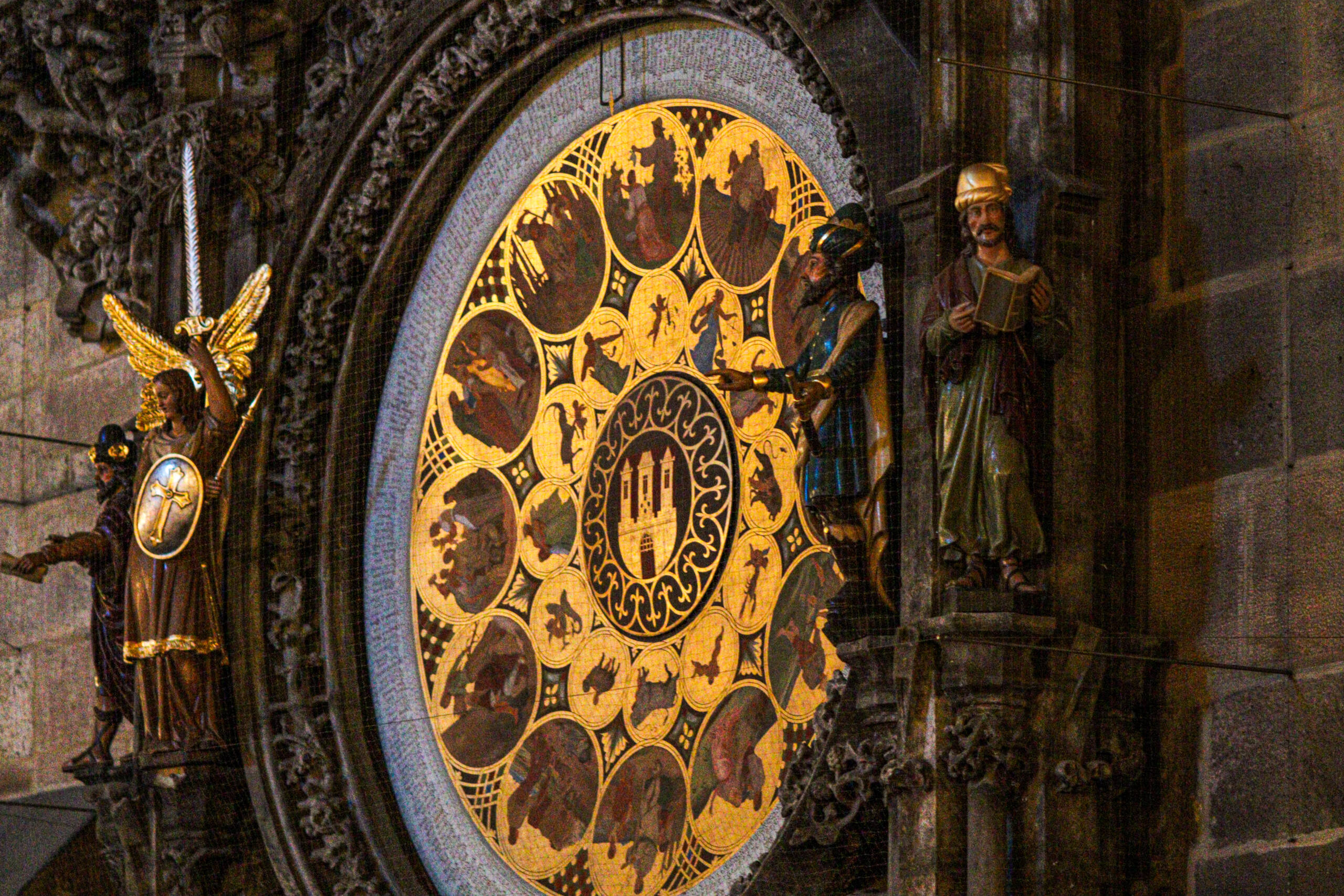
The lower dial of the Prague astronomical clock, the Orloj, is a calendar built from circles. Twelve outer medallions show the months as scenes of country work, with the signs of the zodiac in smaller circles inside them. At the centre sits the coat of arms of Prague’s Old Town, a castle with three towers. Gold, dark paint and a pale outer ring separate each layer from the next, so the eye reads the structure long before it can read the pictures.
Shot at an angle, the circle becomes an ellipse, and that helps. Seen straight on, a dial just sits there; tilted, it starts to recede. The statues on either side do the rest. On the left the archangel raises a sword over a shield marked with a cross, and on the right the chronicler reads from his book. These upright figures bracket the round shape. Without them the dial floats. With them it’s framed.
There’s a catch, and at 100mm you can see it. A fine anti-bird net covers the whole dial, its threads crossing the gold in a faint grid. It can’t be removed and sits too close to the painting to fall out of focus. The night guide to the Orloj has the practical answers: shoot as square-on as the lane allows, and go easy on sharpening, which outlines every strand.
One more thing worth knowing: the painting is a copy. Josef Mánes painted the original calendar in 1866, and it has long been kept indoors at the City of Prague Museum. The copy fitted during the clock’s 2018 restoration drew so much criticism that in 2023 the city commissioned another from the Academy of Fine Arts. The circle stays put. The brushwork on it keeps changing.
Frame notes. Canon EOS R100 with an adapted EF 100mm f/2 USM, 1/100 s at f/2, ISO 6400, October 2025. Late at night the square empties and the lit dial becomes the brightest thing in the frame. Meter for the gold and let the stone go dark.
FRAME 02 · A CONTAINER PORT
The Grid That Moves the World’s Cargo
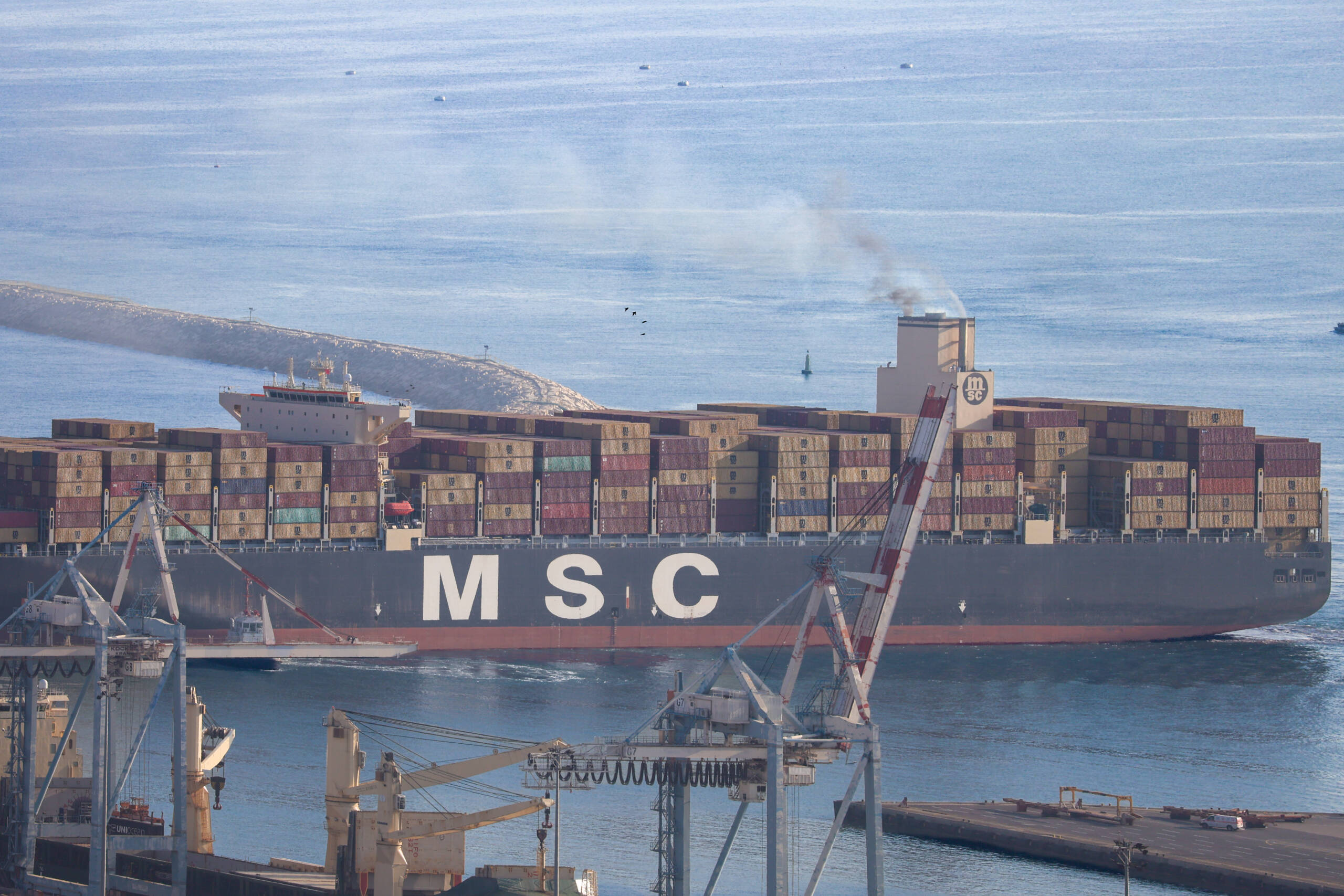
On a container ship the rectangles are doing real work. Every box on that deck is built to the same international standard, 8 feet wide and usually 20 or 40 feet long, which is why the cargo stacks into such a regular grid and why the industry counts capacity in TEU, twenty-foot equivalent units. The colours change from box to box. The module doesn’t. Mediterranean Shipping Company, whose white initials run along this hull, has been the world’s largest container line by capacity since early 2022, so those three letters turn up in a lot of ports.
The cranes in front break the order. Their booms run on the diagonal and their cables hang loose, and a plume of exhaust from the funnel adds the only soft edge in the picture. Behind the ship, a curved breakwater and a wide field of water give the eye somewhere quiet to finish. Complexity needs a place to stop.
The long lens is what makes this work. From high ground at 400mm, the cranes, the ship and the breakwater are hundreds of metres apart, yet they lie on top of one another like sheets of paper. People call this telephoto compression. What actually flattens the scene is distance: perspective depends on where you stand, and the long lens simply crops a narrow slice of a view in which depth has already shrunk.
Frame notes. Canon EOS R8, RF 100–400mm at 400mm, 1/400 s at f/8, ISO 125, August 2026, early morning. Low sun puts a shadow edge on every stack. Find a high viewpoint over a port and the deck turns into a plan drawing.
THE UNDERLYING IDEA
The subject changes. The visual grammar travels.
FRAMES 03 AND 04 · GUIMARÃES AND SAINT-ÉMILION
An Opening, Then a Row
A Frame Inside the Frame
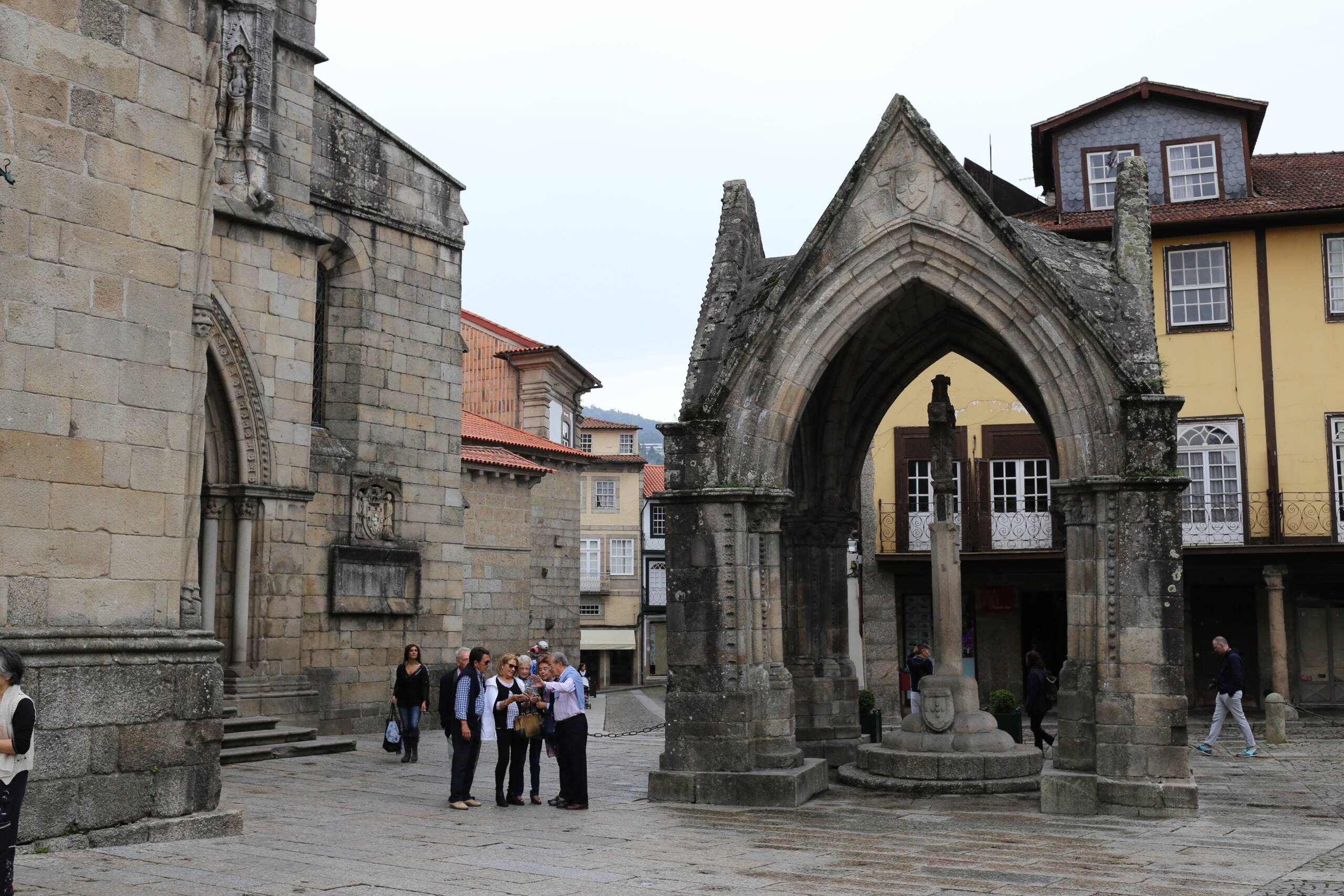
The pointed stone canopy in Guimarães is the Padrão do Salado, put up in 1342 to mark the Battle of Salado two years earlier, when the kings of Portugal and Castile defeated a larger invading army in southern Spain. A Lisbon merchant, Pero Esteves, paid for it. It shelters a raised stone cross and stands beside the church of Nossa Senhora da Oliveira, in the middle of the UNESCO-listed old town.
Photographically, it’s a picture inside a picture. The dark interior of the arch holds the slender cross, and the yellow façade behind it shows through like scenery on another stage. The church wall to the left is a field of rectangular blocks, and below it a group of visitors talks on the paving, their loose poses softening all those straight edges. Doorways, arcades and windows earn their place in so many photographs for this reason. They cut a view out of its surroundings without hiding where it is.

Rows That Lead Somewhere
In Saint-Émilion the order comes from work. Rows of vines divide the foreground into narrow green bands and lead up toward limestone walls, tiled roofs and the spire of the bell tower above the town’s monolithic church, a church carved out of the rock itself. UNESCO inscribed the whole jurisdiction in 1999 as a cultural landscape, a formal way of saying that the vines and the town are one composition.
The rows don’t need to point straight at the spire. They only have to give the eye a rhythm and a direction. The town then interrupts that rhythm with roofs, garden trees and the openings cut into the rock wall on the left, and above it all a heavy sky ignores the geometry completely. The picture moves from strict repetition at the bottom to something much looser on top.
Frame notes. Guimarães: Canon EOS 6D, EF 40mm f/2.8 STM, 1/250 s at f/6.3, ISO 400, October 2015. Saint-Émilion: July 2018, no camera data on the file. With an arch, step back until the whole opening sits inside your frame with a margin on each side, then wait for the people under it to settle.
Repetition gives the eye a route. A small interruption gives it a destination.
FRAME 05 · LYON
The Pause in the Pattern
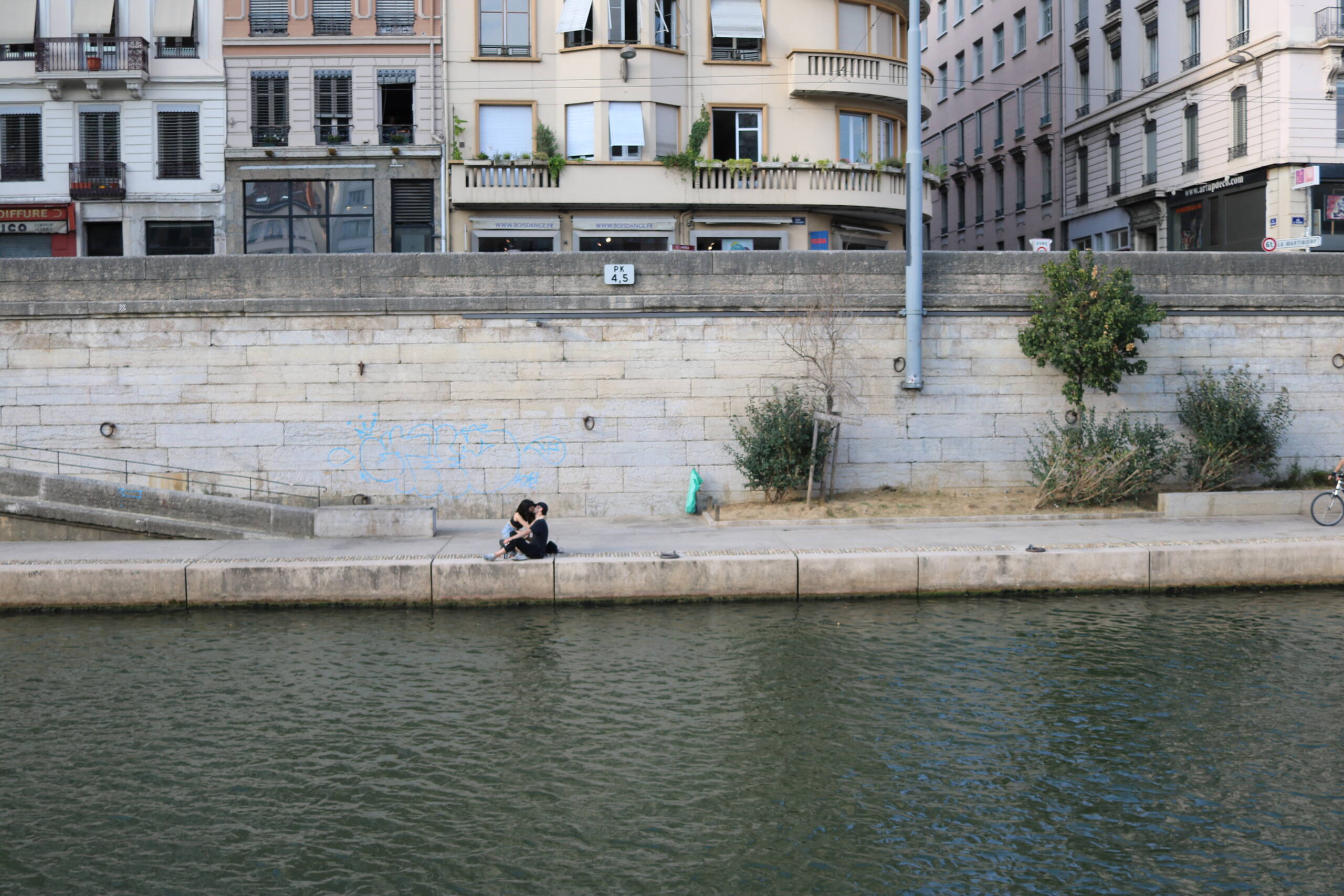
In Lyon, two people take up about one percent of the frame and change almost everything about it. The picture is built in horizontal bands: dark water, the pale lip of the lower quay, a broad retaining wall, then the buildings above. Stone courses and rows of windows repeat across the width. A grey pipe drops straight down through the wall, shrubs and a patch of blue graffiti roughen it, and a small plaque reads PK 4,5. That’s a point kilométrique, the distance marker used along French waterways.
Without the couple this is a study of a river wall. With them it becomes a place someone chose to spend an evening. They’re the exception to the repeated forms around them, and also the reason those forms register at all: the eye finds the figures, sizes them, measures the wall against them and comes back. It’s an economical loop, and it only works because they’re small. Dark clothes against pale limestone do the rest; at that distance contrast is worth more than sharpness.
There’s more on that discipline in Shooting People Small on the Saône Quays.
Frame notes. Canon EOS 760D, EF-S 24mm f/2.8 STM, 1/500 s at f/3.2, ISO 100, July 2018, shot from the far bank in the evening. Compose the empty wall first and wait for someone to walk into it. Then resist the crop.
FRAME 06 · WROCŁAW
A Pattern That Swims
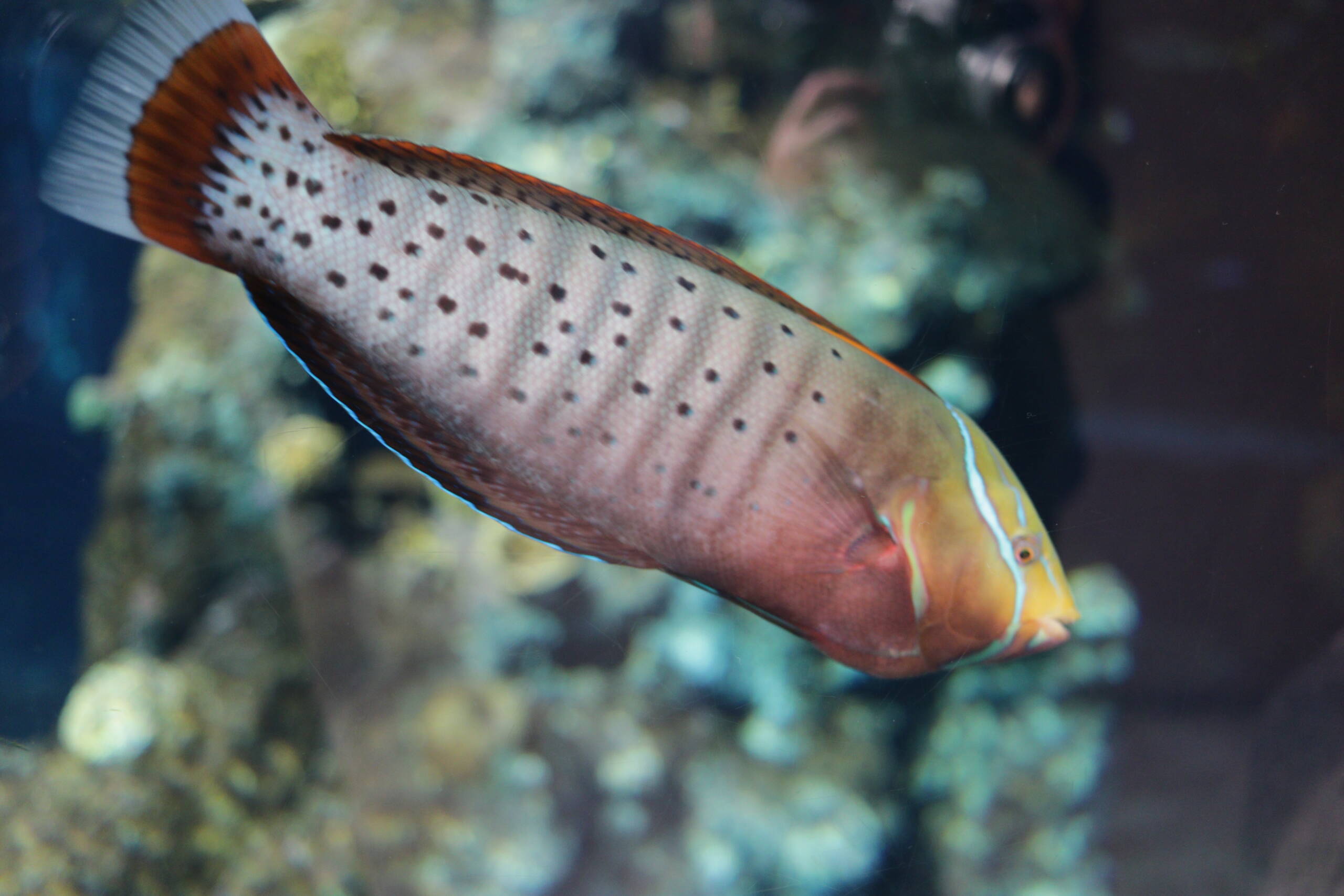
The last frame carries its pattern with it. This wrasse was photographed through the glass of the Afrykarium, the aquarium of African waters that opened at Wrocław Zoo in 2014. Dark spots are scattered over a pale pink body, an orange band runs ahead of the tail, and thin blue-white lines trace the yellow head. It crosses the frame on a diagonal, tail at the upper left and mouth at the lower right, while rock and coral dissolve into a soft blue-green behind it.
The spots have none of the regularity of the containers, which is the attraction. They vary in size and spacing, and the body curves under them. The same habits still apply, though: the repeated spots hold attention, and the diagonal does the job the cranes did on the ship. A fish and a freight ship have almost nothing in common. In a photograph they can share a grammar.
Frame notes. Canon EOS 760D, EF-S 24mm f/2.8 STM, 1/250 s at f/3.2, ISO 800, March 2019. Put the lens close to the glass to kill reflections, and press the shutter when the fish turns side-on. Head-on, it’s a smudge.
Four Habits for Finding Geometry on Any Walk
Name the Shape First
Before you raise the camera, say what the main shape is: a circle, a grid, a set of rows, an opening. If you can’t name it, the picture probably has no structure yet.
Find the Break
A pattern on its own gets dull fast. Look for the crane across the containers, the couple against the wall, the cross under the arch. The break is where the eye lands.
Walk Back and Zoom In
A telephoto from a distance flattens depth and turns separate objects into one design. The further back you stand, the harder the layers press together.
Square Up to Frames
Arches, windows and doors read best when you face them squarely and keep their edges straight. A tilted frame inside a frame looks like an accident.
A SMALL EXERCISE FOR THE NEXT WALK
Look for the shape. Then let the subject surprise you.
Keep looking. Two companion essays use the same way of seeing on people and places: Stop Waiting for an Empty Frame makes the case for the crowd, and The World Between the Landmarks follows what happens around the famous views. Guimarães turns up again in Photos of the Week, and Saint-Émilion in A Collection of Travel, Art and Everyday Scenes.