
Six photographs / One argumentLet them
stay.
A photo essay
On being there
With everybody else
The empty view is only one version of a place. These six photographs make a case for the people in the way.
A photo essay about the people we are tempted to wait out.
There is a familiar little ritual in travel photography: raise the camera, notice the people, lower the camera, wait. Somebody is standing in front of the thing. Somebody else has stopped exactly where the composition wants a patch of empty pavement. In a minute, surely, they will move. Sometimes they do. More often another person replaces them, and the photographer spends the afternoon negotiating with a place that is simply being used.
These six photographs suggest a more interesting bargain. Let the people stay and ask what they contribute. A crowd can establish scale, explain an event, turn a public space into a pattern or disappear into the soft background of a private conversation. The useful question is not how to get rid of everyone. It is how much of everyone the picture needs.
01
The spectators / Scale
The opening photograph almost makes the argument on its own. A huge wooden elephant fills the frame, its jointed trunk curled in front of long pale tusks. Metalwork interrupts the timber; a broad canopy rises above the balconies; a crane and industrial buildings remain plainly visible behind it. Visitors lean over the upper railings, with a cluster of fluorescent yellow-green vests making a bright stripe against the wood. At ground level, a few people look tiny beside the legs. Those two groups do different jobs. The people below tell us how enormous the machine is. The passengers above tell us what it is for.
Without them, the elephant would still be an impressive object. With them, it becomes a social invention: something built to be climbed into, watched, pointed at and remembered together. That is a much richer subject than a clean photograph of the engineering.
02
The observer / Attention
Someone else
is making a picture.
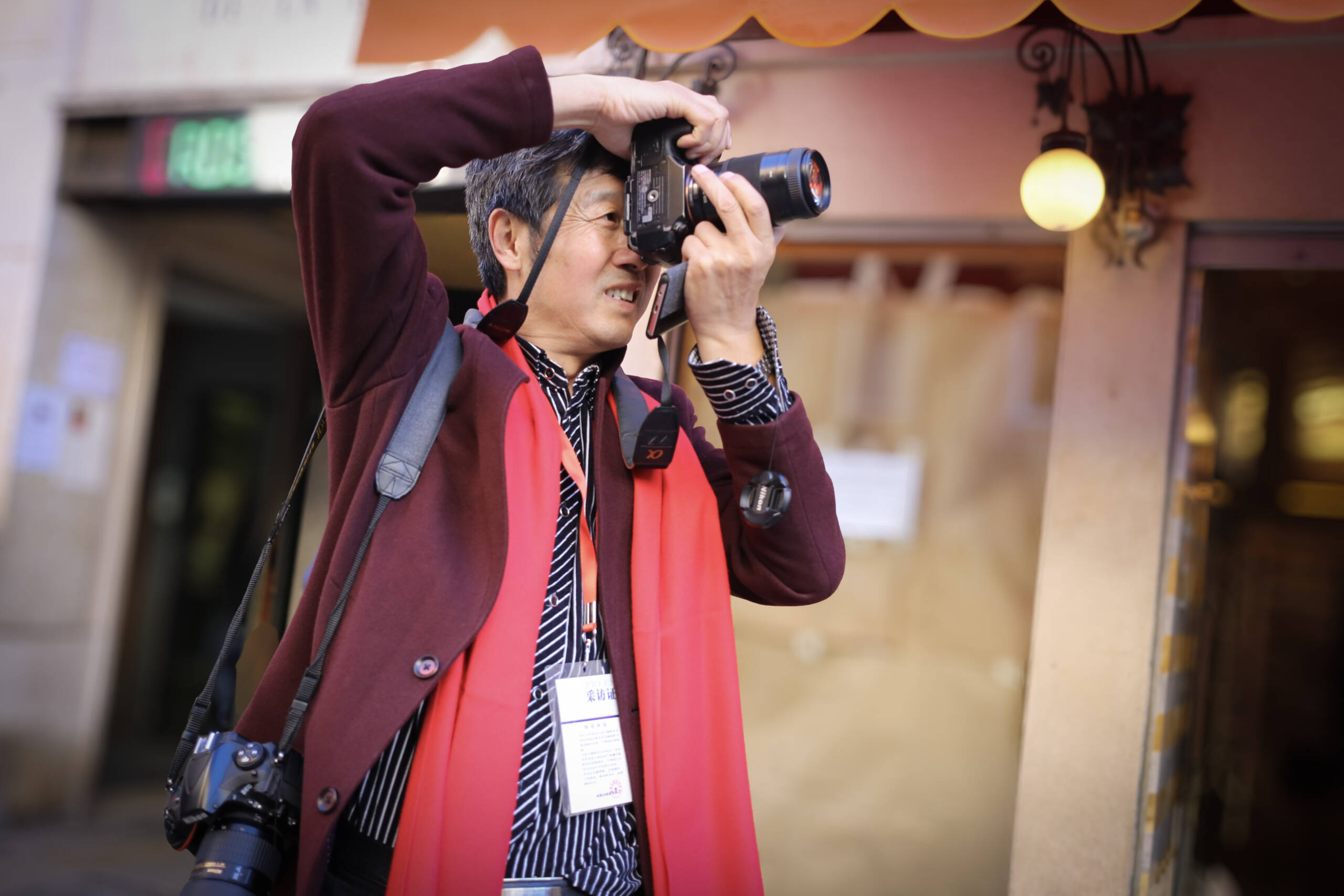
The photographer in the burgundy coat is not posing for this frame. His raised elbow forms an arch above his head, his red scarf drops almost vertically, and the camera hides part of his face. Another body hangs at his hip. A phone is held alongside the camera at his eye, and a credential card rests against his striped shirt. In the background, a round yellow lamp echoes the warm colours without competing with them.
His subject is outside our picture. His concentration is inside it. There is no need to know exactly what he is photographing for the gesture to work. In a crowd of spectators, the person looking hardest can become the most revealing subject.
A change of perspective
The person blocking your view may be the reason to take the photograph.
03
The event / Several centres
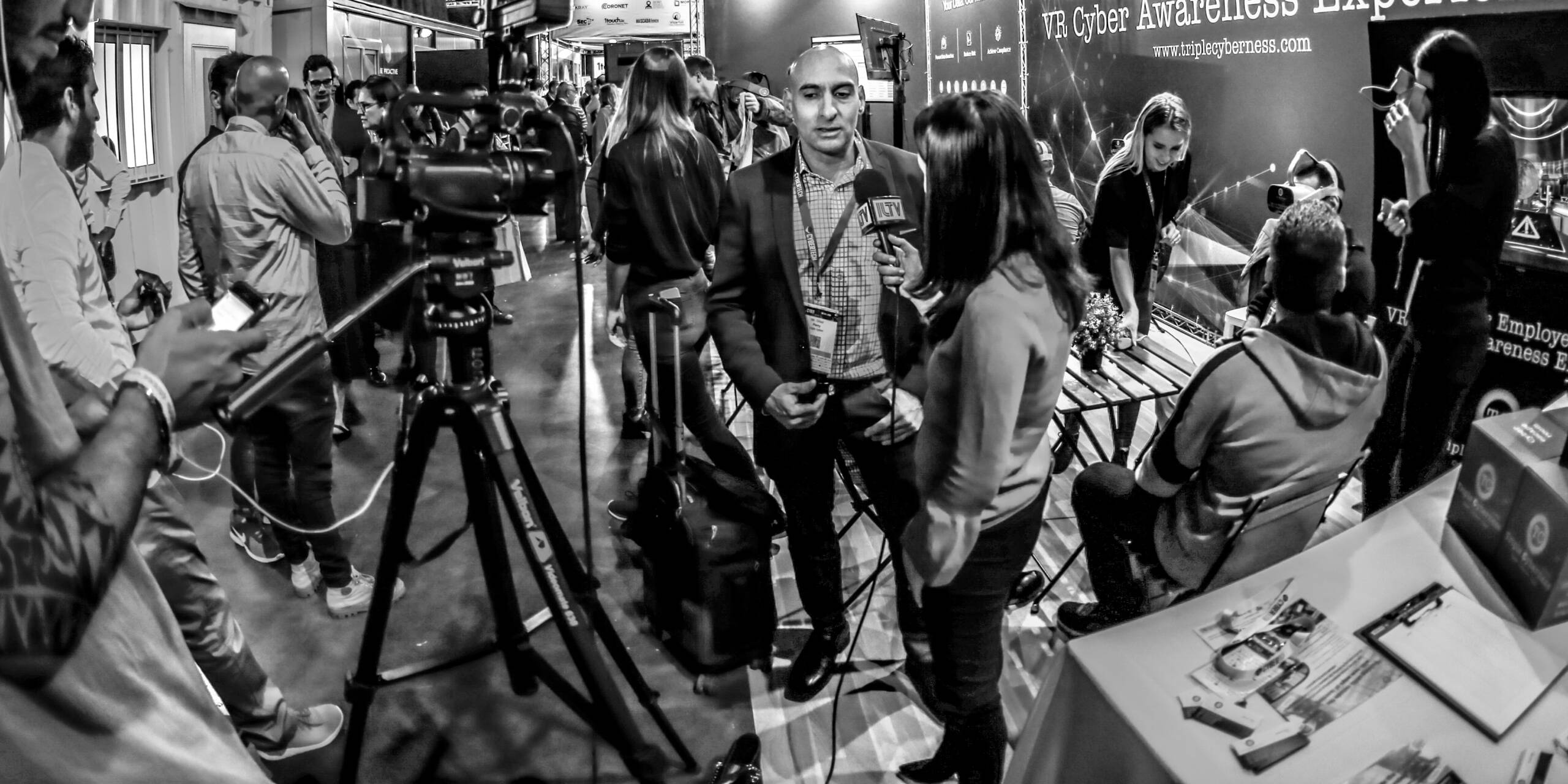
At the trade show, attention splits. A broadcast camera and its tripod occupy the left foreground; a man wearing a badge speaks towards a reporter’s microphone in the middle. To the right, another visitor sits wearing a virtual reality headset while staff and equipment surround him. People behind the interview keep walking. Booth lettering, cables, bags and a table covered with printed material fill the remaining spaces. It is busy because the event is busy, and the photograph lets that fact stand.
The monochrome treatment removes one source of competition, but it does not turn the scene into a tidy portrait. We can follow the official conversation, then wander into the demonstration beside it, then look at the people passing through. The interview will probably produce a close shot in which most of this disappears. Here, the apparatus of producing that shot is part of the story. A wider frame can show the event and the machinery of attention at the same time.
04
The conversation / Intimacy
A crowd can
become quiet.
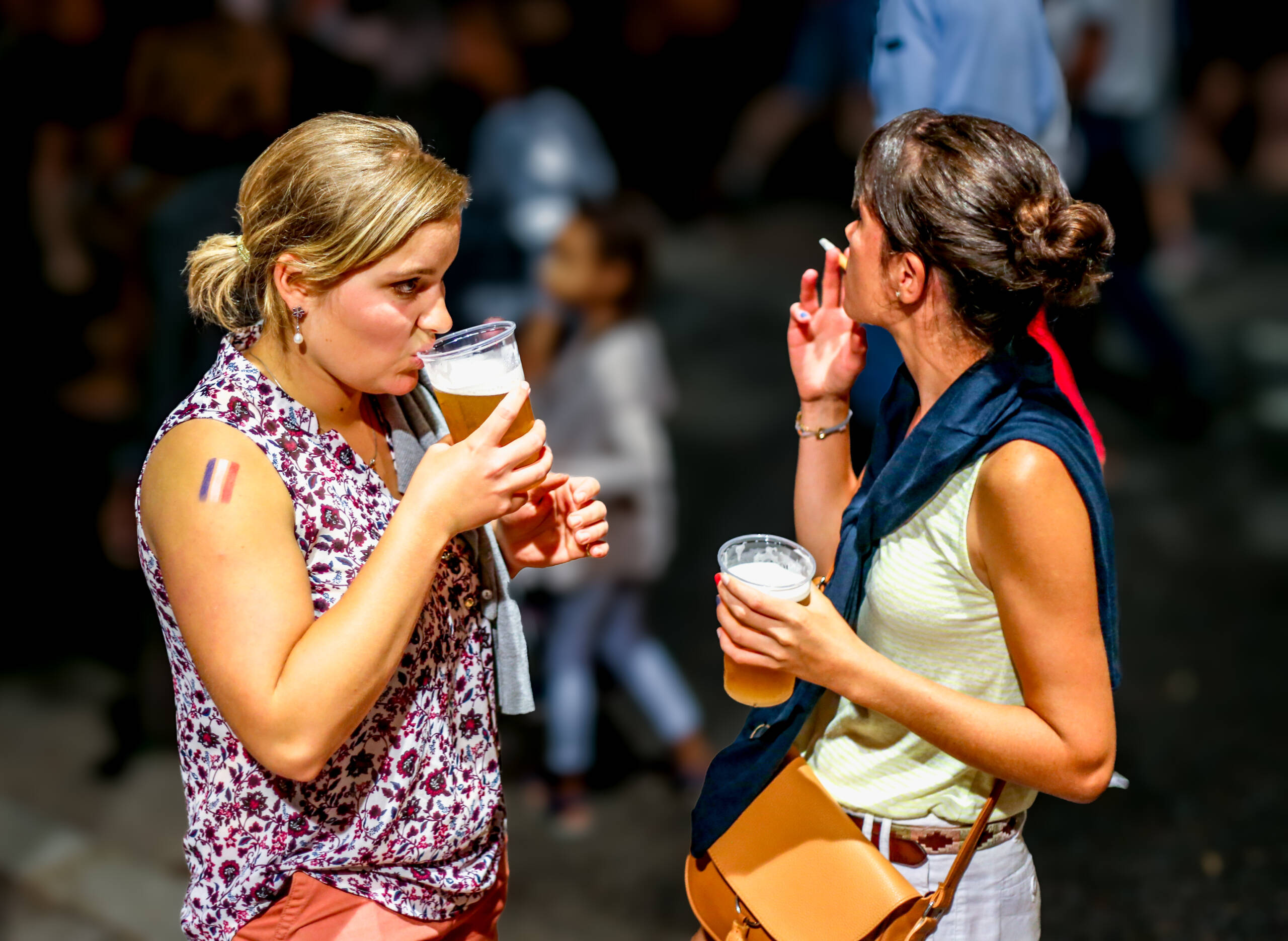
Two women hold plastic cups of beer in strong sunlight. One drinks, the blue-white-red stripes painted on her upper arm adding a small visual clue; the other turns away with a cigarette raised near her face. A mustard-coloured bag crosses the lower right. Their hair, hands, cups and clothes are sharply described, while the people behind them dissolve into a dark, soft background.
This is still a crowded setting. The difference is how much access the background is given to our attention. The gathering supplies context and colour, but the foreground moment keeps its privacy. There is no grand incident to explain, only two people sharing the same patch of light while doing slightly different things. A good crowd photograph does not always look crowded.

05
The beach / Pattern
At the beach, distance changes the subject again. White umbrellas dotted with small coloured rectangles repeat across the sand. Red loungers point towards the water at slightly different angles. Beyond them, swimmers stand in the pale shallows, curved lines of foam approach the shore, and a rocky breakwater divides the swimming area from the darker sea. The frame is built in layers, with holiday furniture and bodies at the bottom and increasingly open water above.
No single beachgoer has to carry the picture. Together, the people explain why the chairs and umbrellas are there, interrupt their neat repetition and give the scene its scale. The effect is almost diagrammatic, but never quite: a vacant lounger, a tilted parasol, someone walking between the rows. Leisure has an infrastructure, and from this viewpoint it becomes visible.
Sometimes people give a photograph a subject. Sometimes they give it a rhythm.
06
The street / Passing arrangements
The street gets the last word.

In Prague, a group walks towards the camera across small grey cobblestones. A pink scarf catches the left edge; long checked scarves divide the darker coats into vertical strips; pale trousers and white shoes brighten the centre. A café umbrella and leafy tree anchor one side of the street, while elaborate façades, glass shopfronts and an orange service vehicle recede behind them.
The pedestrians are close enough to disturb the architecture’s clean perspective, and that disturbance is useful. Their different directions of attention prevent the scene from becoming a procession. Some look sideways, others ahead; the city continues around them. Wait until they have all gone and another version of Prague appears, certainly. But this version contains something the empty street cannot supply: the passing arrangement of people who happened to be there together.
Before waiting for everyone to leave, try one photograph that lets them stay.
An empty frame can be beautiful. It can also be incomplete.