Places are made of interruptions.
A visual essay on the places we remember—and the small interruptions that make them real.
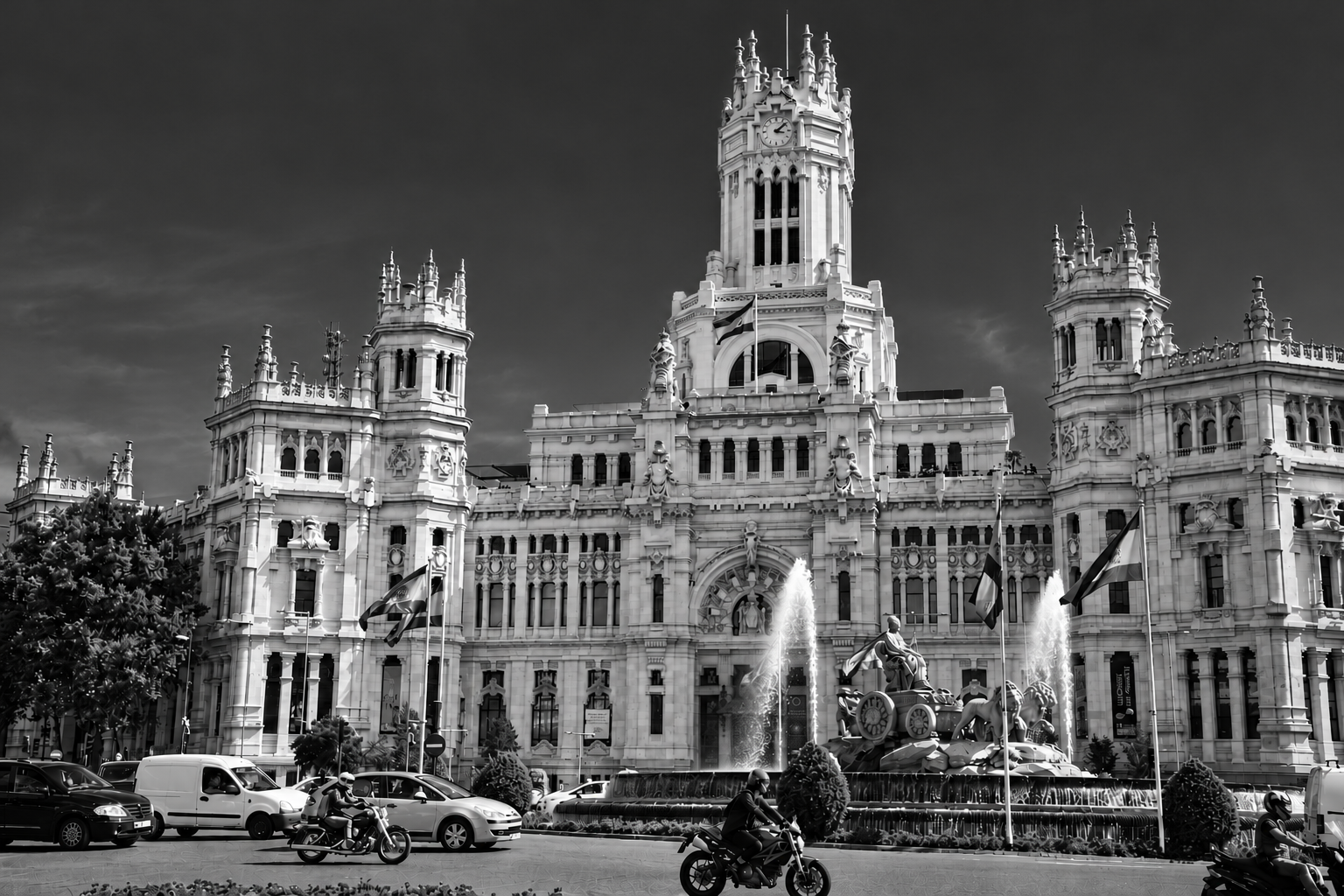
A city introduces itself with a building, then spends the rest of the day distracting you from it. Madrid’s Palacio de Cibeles makes a formidable opening statement: pale towers climb into a darkened sky, the central clock watches over the square, and rows of windows turn the façade into an almost musical arrangement of repeated lines. Below, the fountain throws white water into the air while cars, a delivery van and motorcycles cross the foreground. The building wants to be timeless. The traffic has somewhere to go. That disagreement is where the photograph begins to feel alive.
These pictures belong to different places and different moments. They are not the record of a single journey. What connects them is a way of looking: letting the famous object establish the scene, then paying attention to everything that happens around it. A street opens onto a fountain; visitors become part of a painting’s surroundings; a box of fruit offers as much colour as an entire gallery. Sometimes the most useful thing a photograph can do is lower its ambitions a little. There, on the edge of the obvious subject, another story is waiting.
Vienna arrives through a gap.
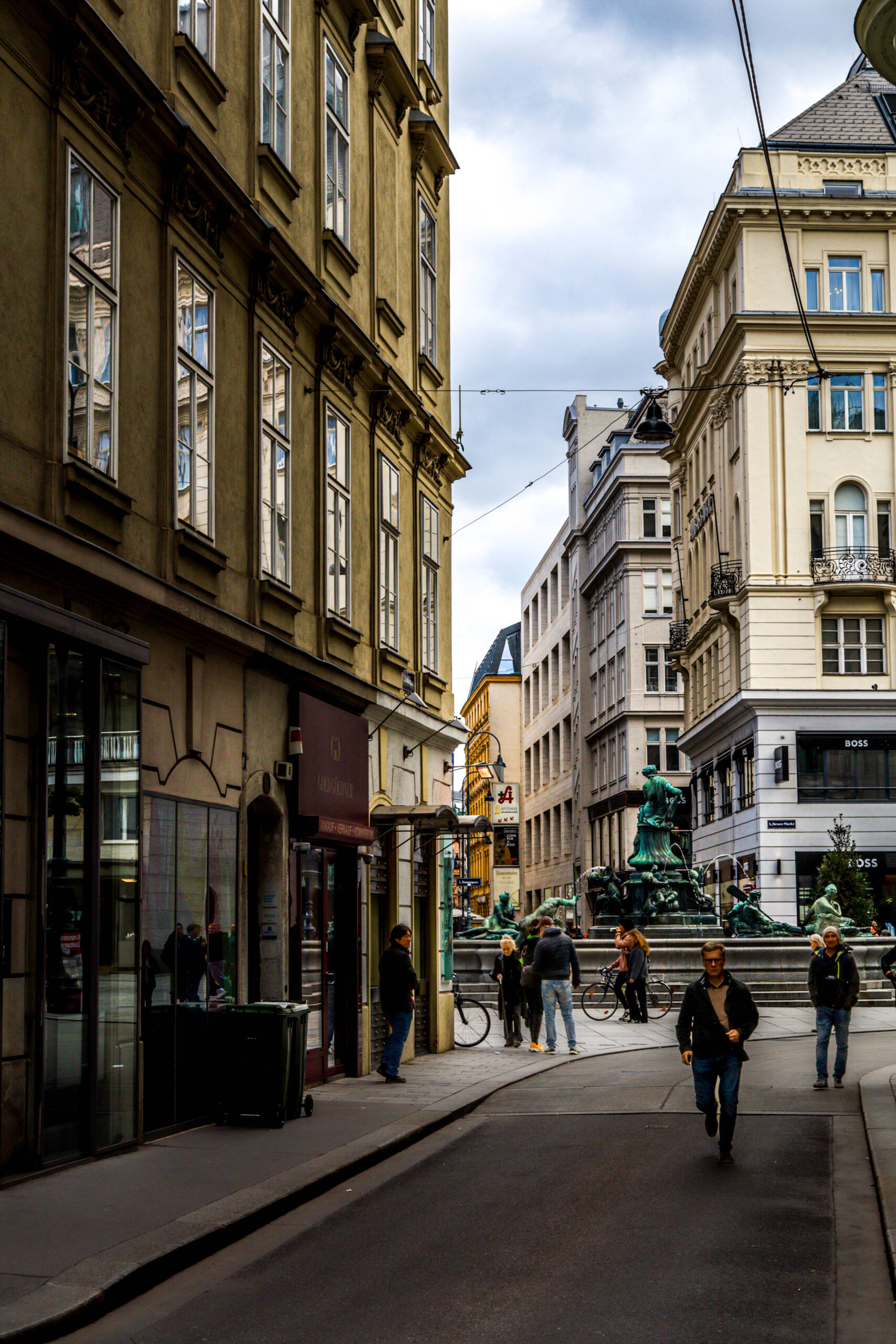
The lane holds you between two walls of windows. On the left, an ochre façade is dark enough for the reflections in its glass to become small pictures of their own. On the right, cream stone and blue-tinged panes open the view towards Neuer Markt. The green figures of the Donnerbrunnen appear at the end, but a man walking towards the camera occupies the more immediate world. Overhead wires cut across the cloudy sky; shop windows, bicycles and people prevent the architecture from becoming a sealed historical exhibit. The pleasure here is the gradual reveal. You do not have the whole square yet, and that is rather the point.
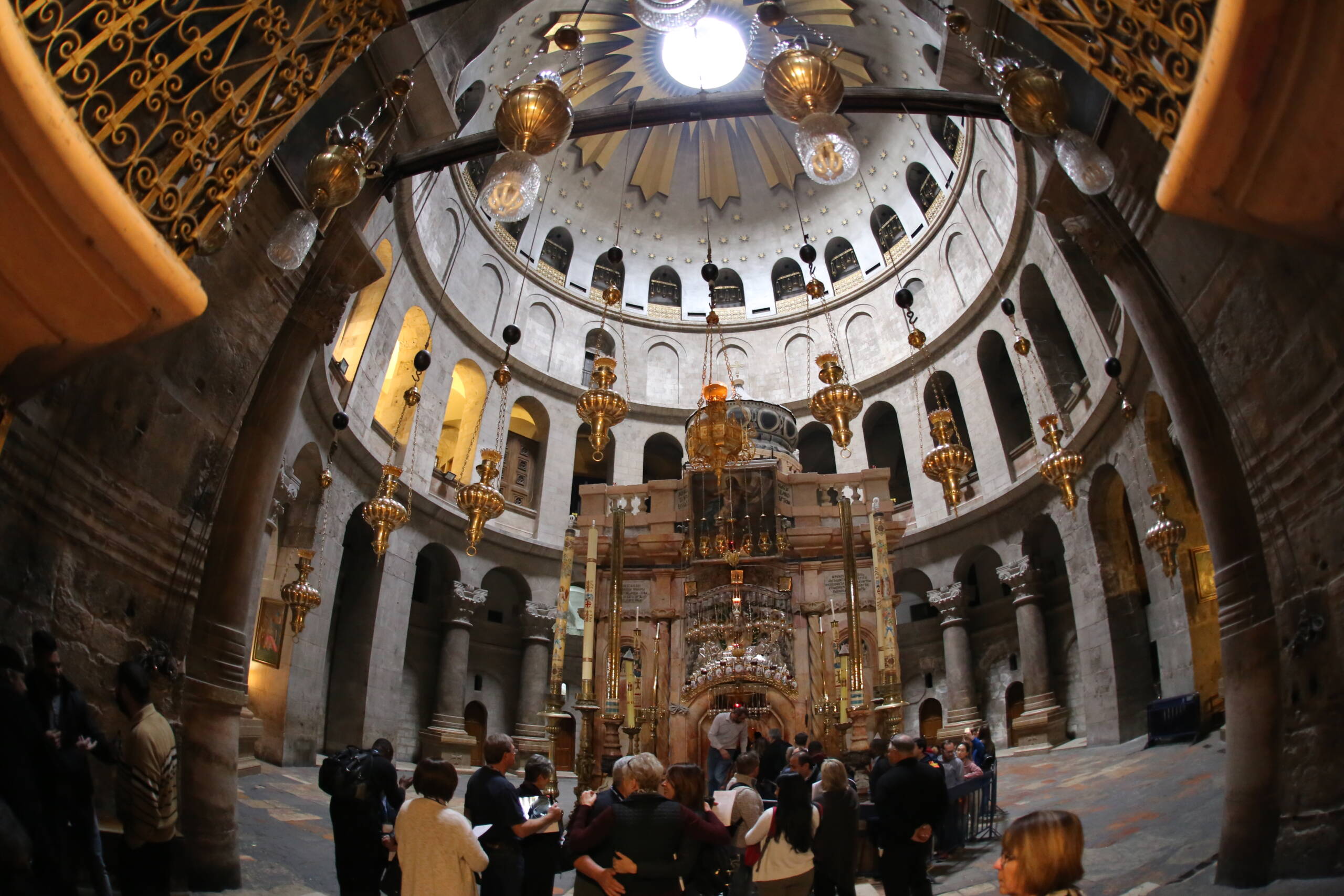
Inside the Church of the Holy Sepulchre, the view expands abruptly. The dome draws the eye to a bright opening high above, while curved tiers of arches descend around the central shrine. Gold-coloured lamps hang at different heights, threading the empty air with chains, glass and metal. Massive dark pillars bracket the scene. Along the bottom, visitors gather, turn, wait and look; their shoulders and heads form an irregular, human foundation beneath the architecture. Remove them and the picture would still describe an extraordinary interior. Leave them in and it describes an encounter with that interior. The difference is not small.
A room full of looking.
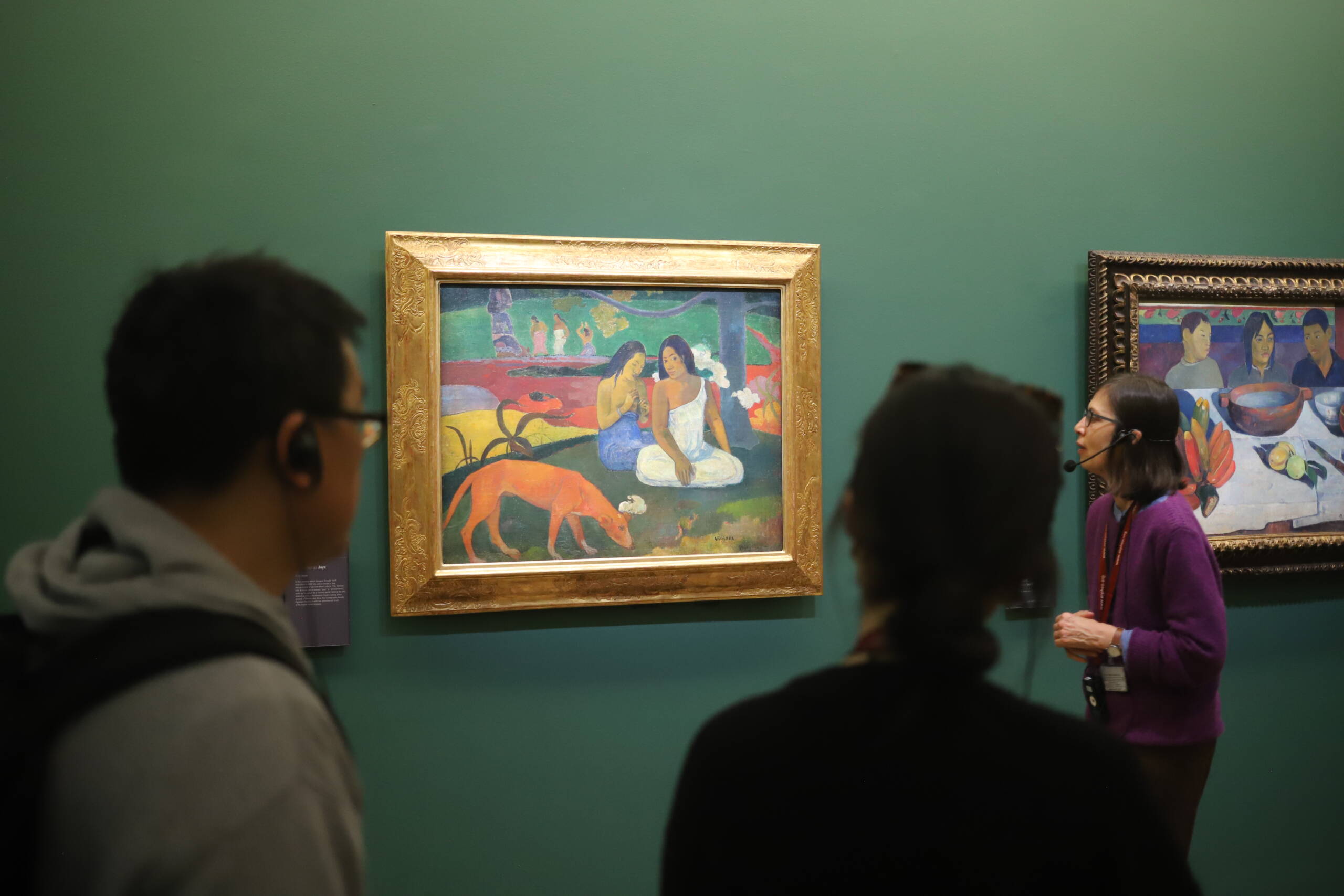
The museum photograph reverses the direction of attention. We are watching people who are watching pictures. Two dark, softly focused visitors occupy the foreground, a guide in a purple sweater stands to the right, and Gauguin’s saturated colours hold the centre inside an elaborate gold frame. The deep green wall allows the orange-red animal in the painting to flare forward. Purple, green, gold, orange: the room has quietly assembled a colour composition that extends beyond the canvas. The visitors obscure parts of the display, yes, but they also give it a present tense. Art does not spend all its time alone with an empty room.
The eye can travel without going far.
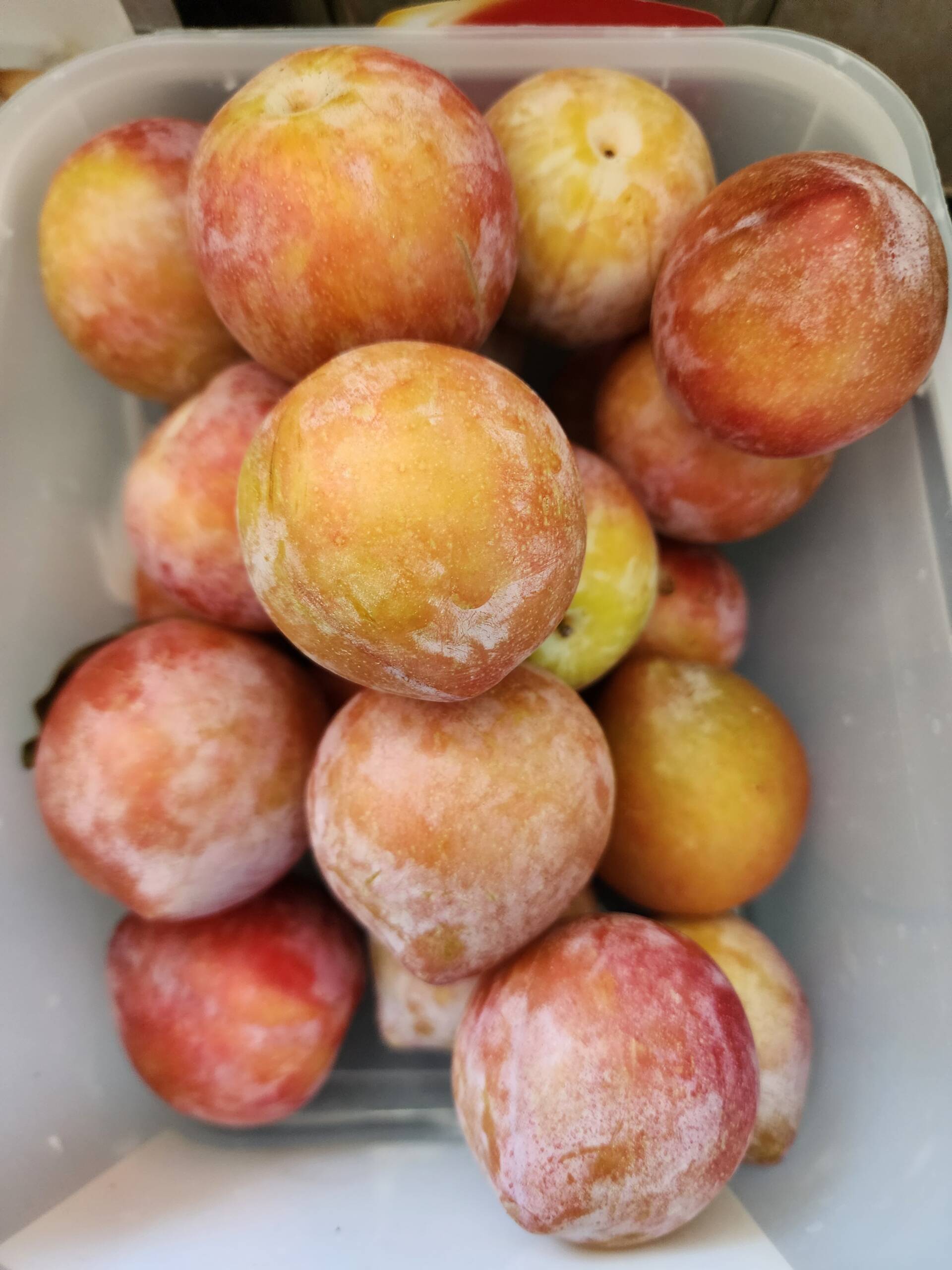
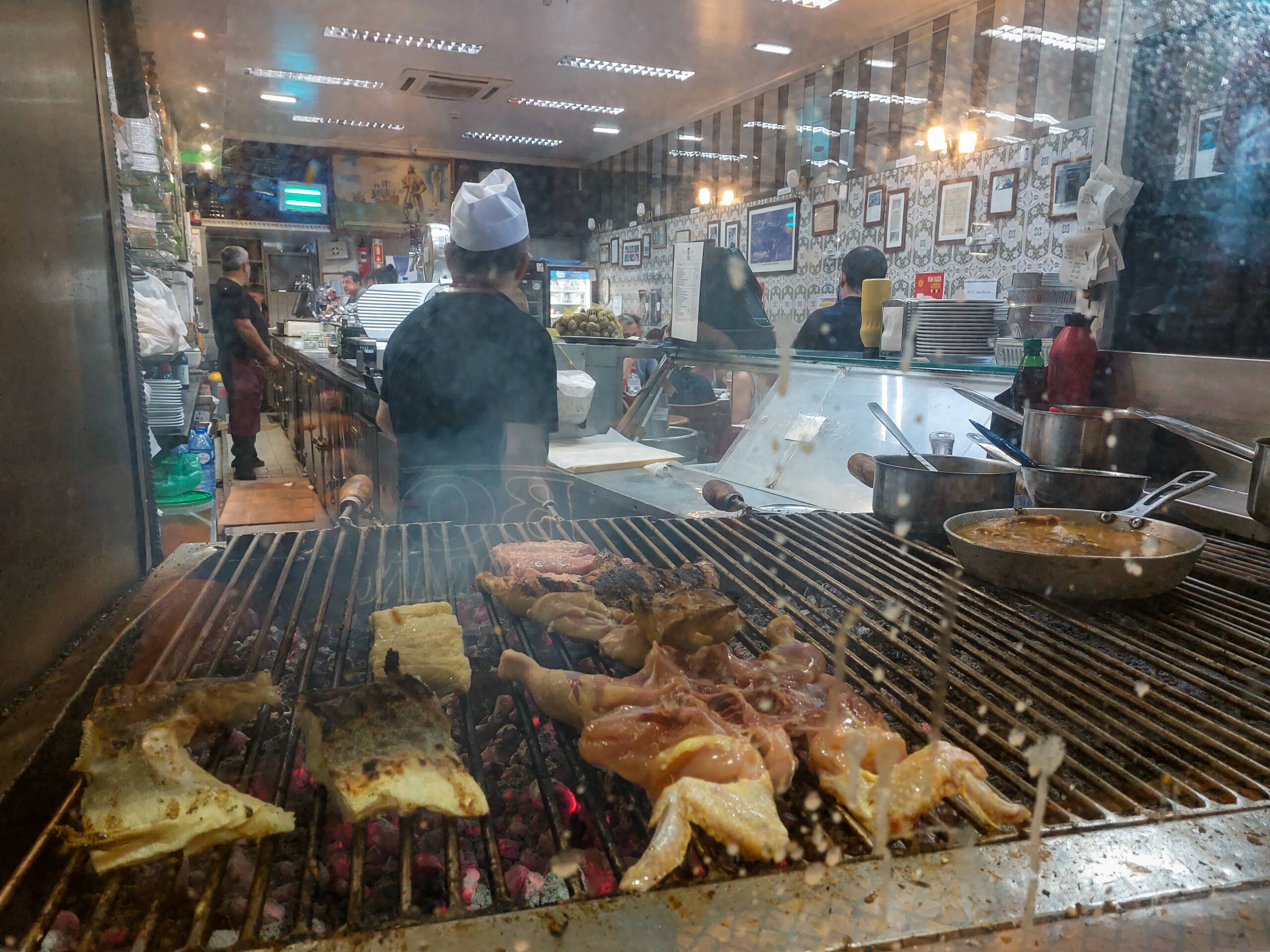
From the gallery to the kitchen is less of a leap than it looks. The plums crowd together in yellow, rose, russet and purple, their pale surface bloom catching the light. The translucent plastic box is still there, an entirely ordinary container doing nothing to dignify the scene. It does not need to. Beside that cool, close view, the grill is all depth and activity: fish and pieces of meat sit above red coals, dark bars score the foreground, pans wait to the right, and a cook in a white hat works beyond the glass. Reflections and smoke soften the room without hiding its clutter. These are two versions of abundance, one held still for a moment, the other being transformed.
Travel memory is full of this supposedly secondary material. The colour of fruit bought for later. The sight through a restaurant window before choosing a table. A tiled wall, a stack of plates, a flame briefly visible under the grate. A monumental façade tells us where we were; these fragments can bring back what being there felt like. They deserve room in the frame, even if nobody prints them on a ticket.
Stone changes its job at the shoreline.
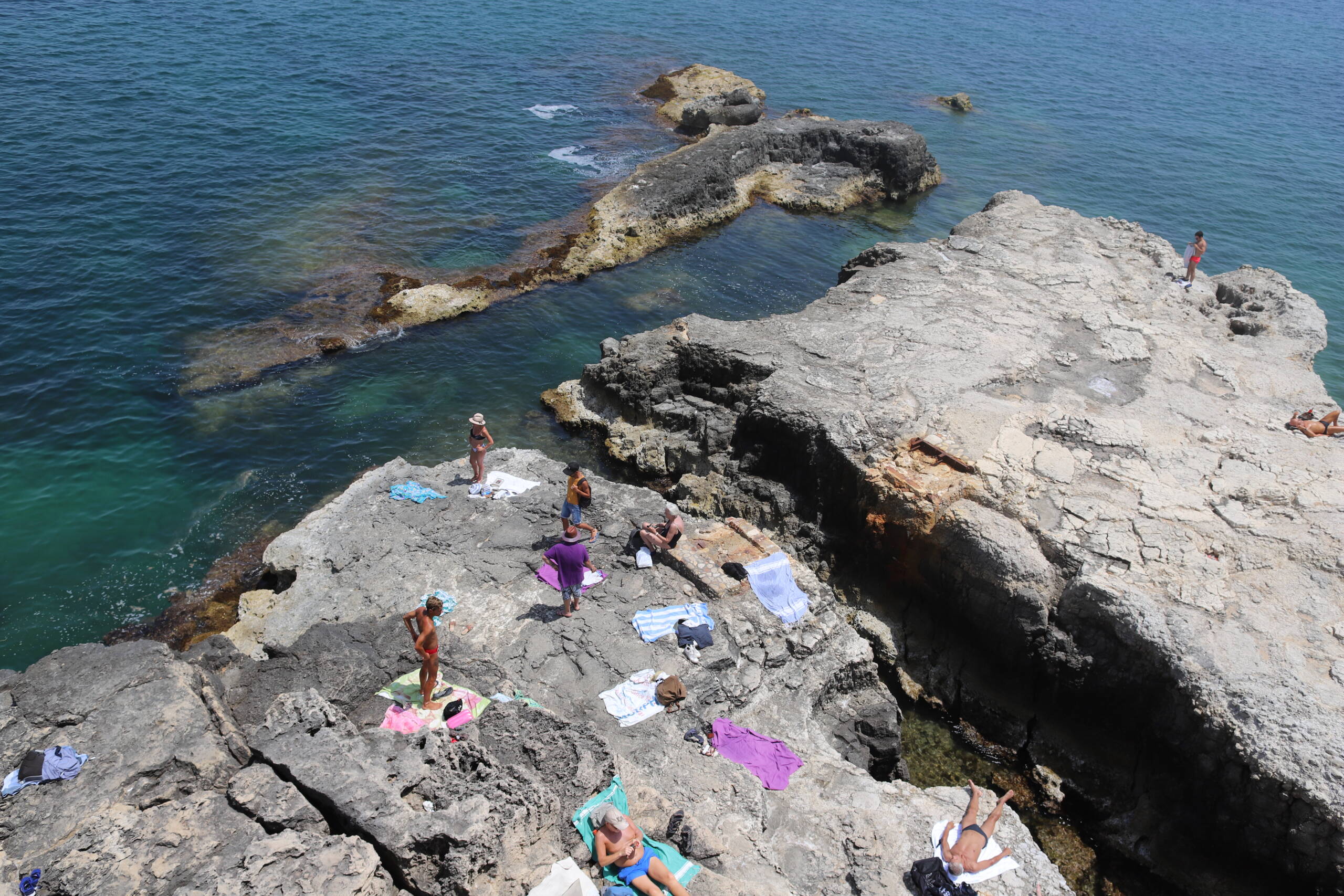
In the city, stone holds a façade upright or raises a shrine above the crowd. Here it becomes a place to spread a towel. The pale rock breaks into ledges, cracks and dark channels; blue water turns green where the bottom approaches the surface. People stand at the edge, sit beside their bags or lie across the uneven ground, and scattered turquoise, purple and white towels make temporary islands of colour. There is no neat central subject. The photograph asks the eye to wander, following a fissure towards the sea and then coming back to a small human gesture. After so many windows, arches and frames, the looseness feels like a release.
And then someone raises a camera.
The woman with the camera is caught in a wonderfully practical moment. Her dark hair fills the left side, one raised hand holds it back, and the other supports a substantial lens; her face is turned towards the camera’s rear rather than offered to ours. Green foliage and pale ground dissolve behind her. It is a picture of concentration, with an interruption built into the gesture. Photography often looks like this from the outside: not a grand creative declaration, just someone trying to see properly while hair, light and the rest of the world get in the way.

The city carries on after the last postcard.
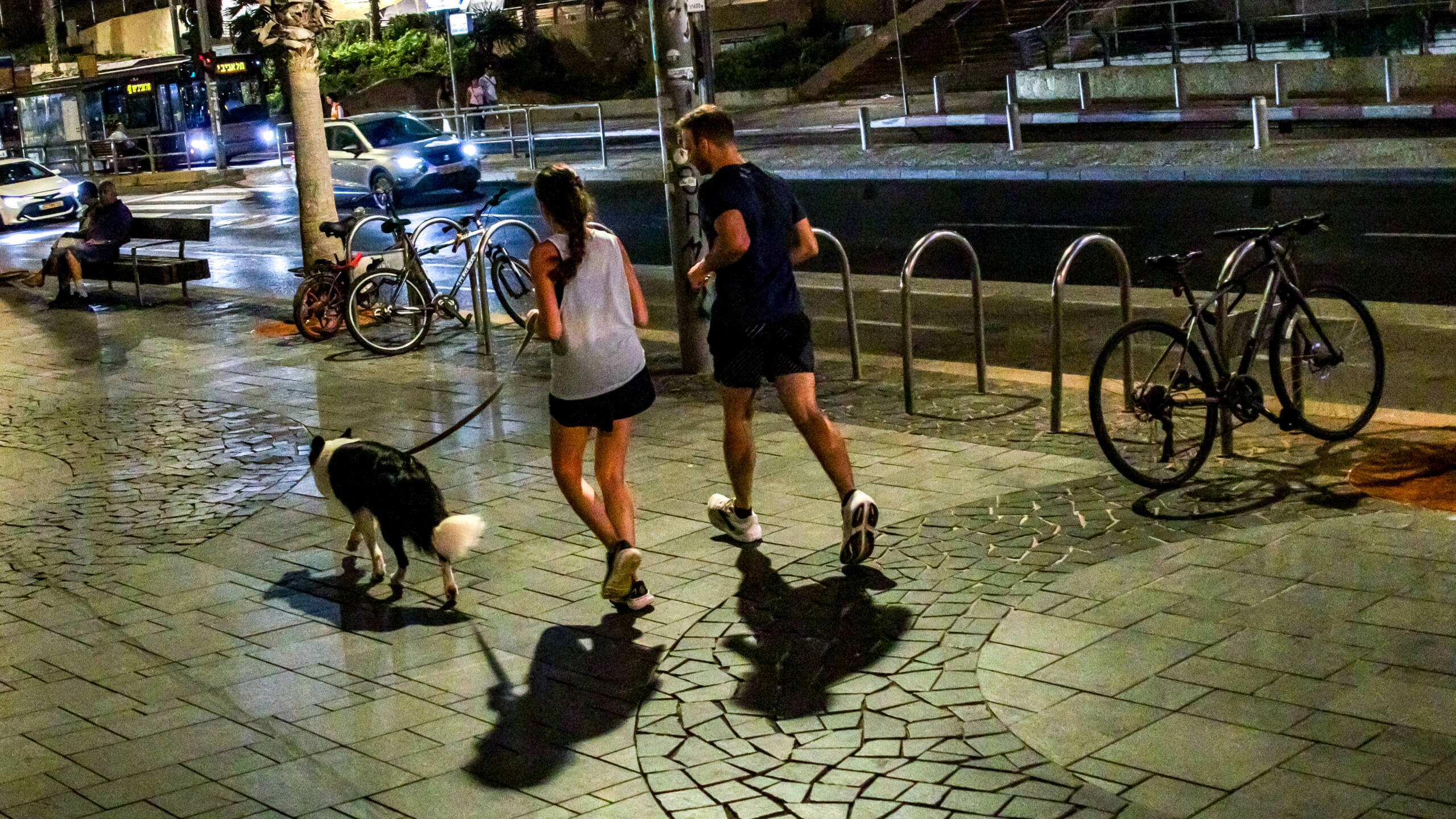
Two runners and a black-and-white dog cross the night-time paving. A leash draws a line between them; shadows stretch towards the lower edge; bicycle hoops repeat beside the road. Headlights and street lighting scatter different colours across the wet surface. Nothing here offers the clean hierarchy of the palace at the beginning. Yet the runners, the dog, the parked bicycles and the person sitting on a bench make the place legible in another way. It is a city being used, at an hour when the visitor’s programme might already be over.
The landmarks remain. They should. But a satisfying archive also keeps the walk towards them, the room around them, the meal afterwards and the stranger crossing the square. Put those pictures beside one another and the world gains texture. You remember the tower; then, unexpectedly, you remember the purple towel on the rocks. That is the sort of memory worth making space for.