Nobody flies to Lyon for Part-Dieu. You come for Vieux Lyon and its Renaissance courtyards, for the basilica sitting on the hill like a wedding cake somebody left out in the rain, for a bouchon where a waiter puts a plate of andouillette in front of you and dares you to finish it. Part-Dieu is the place you arrive and the place you leave from. It is a train station, a mall, and a cluster of towers that look like they were designed by four architects who never once spoke to each other.
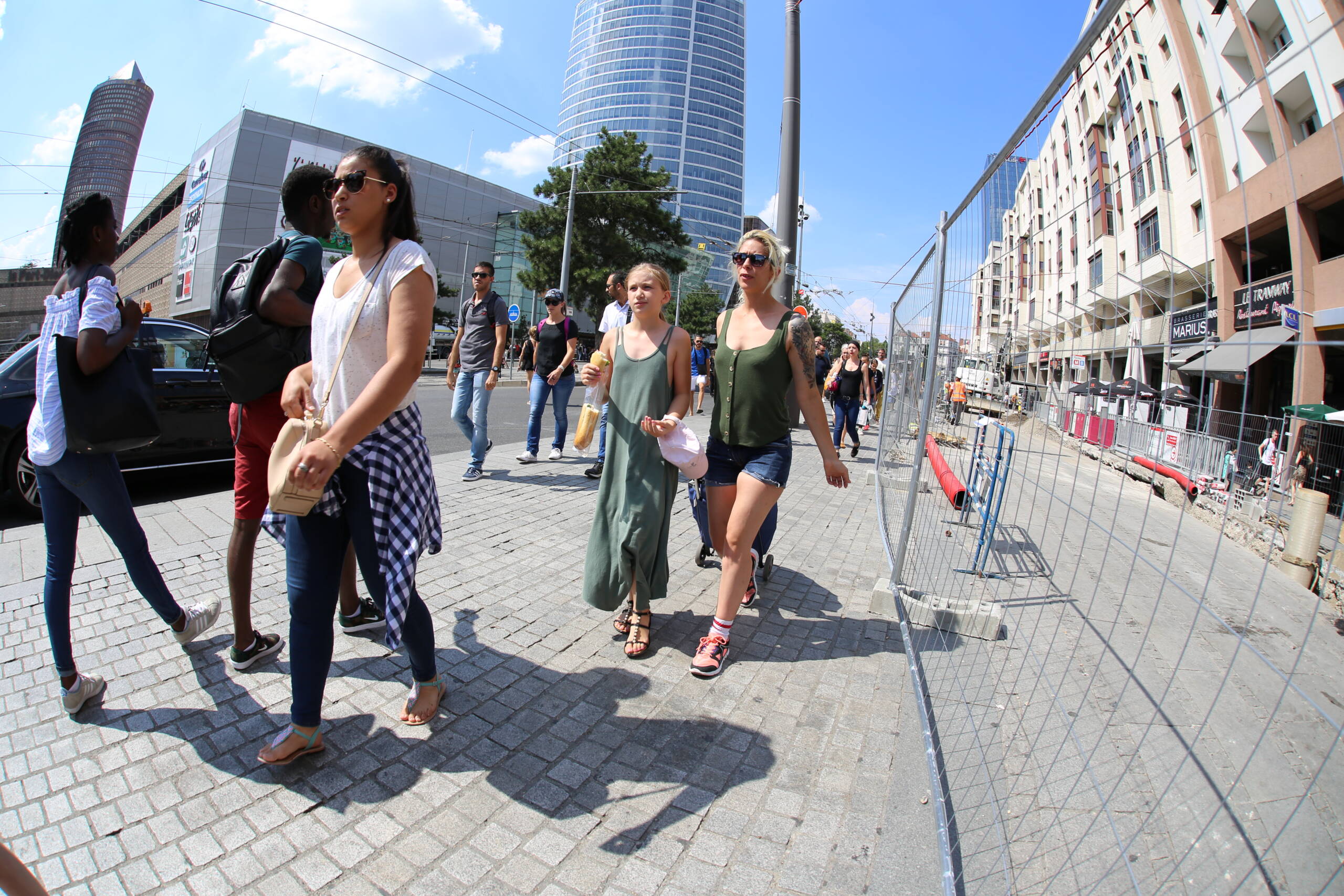
I spent an afternoon walking it anyway, in the kind of July heat that makes cobblestone reflect like a griddle, and I came away thinking it’s the only part of Lyon that isn’t performing.

The Pencil, the Cylinder, and the One That Won
Start with the skyline, because you can’t not. The tapered brown one with the glass point is the Tour Part-Dieu, opened in 1977 as the Crédit Lyonnais tower and known to every single person in this city as Le Crayon — the Pencil. It reaches 165 metres at the tip of its pyramid, and for nearly forty years it was simply the tallest thing in Lyon, full stop. During the Fête des Lumières in December they light it up and it stops being a pencil and becomes a candle. There’s a hotel and a restaurant near the top with a view over the whole Rhône valley to the Alps, which is the single most underrated thing in the district and nobody tells you about it.
The fat glass cylinder next to it is the Tour Oxygène, finished in 2010, 115 metres over 28 floors, roughly 80 percent glass. It is grafted directly onto the shopping centre, so you can walk out of a Monoprix and into the base of a skyscraper without ever seeing the sky. Locals have been calling it the eraser for years, on the entirely reasonable grounds that it sits next to a pencil. Whether the architects intended that joke is a question I have never seen answered honestly.
Neither of them is the tallest anymore. That’s the Tour Incity, which topped out at 202 metres in 2015 and immediately made everything around it look like a scale model. Then in 2023 Dominique Perrault’s To-Lyon arrived beside the station at around 170 metres, a €600 million slab of offices, hotel and retail that exists mostly to prove the district is still growing. Four towers, four decades, four completely different arguments about what a French city should look like. They’re all standing in the same three hundred metres, refusing to agree.
The Fencing Is Not a Phase
Look at the right side of that photograph. Steel mesh panels, red plastic barrier, a small excavator, a man in a hi-vis vest doing something to a trench while two restaurants — a brasserie and a place literally called Le Tramway — keep serving lunch four metres away.
That fencing has been a fixture here for the better part of a decade, and calling it temporary is a category error. The Lyon Part-Dieu project is one of the largest urban renewal programmes in France, and Boulevard Vivier-Merle alone was scheduled for phased reconstruction from 2019 through 2024, in sections, so the district could keep functioning while being taken apart. The idea was to strip surface car traffic away from the front of the station, push it into a lengthened tunnel underneath, and hand the boulevard over to trams, buses, bikes and people. Around the station they’ve since planted thousands of square metres of vegetation, and the Mandela park to the south got 464 trees.
The reason they can’t just close it and get on with it is arithmetic. Part-Dieu station moves on the order of 120,000 people a day. It was built in 1983 for a fraction of that, with its back turned to the neighbourhood, and the whole reinvention project is essentially an apology for that design decision carried out at enormous expense over twenty years.
So you get this permanent condition: a district that is always half-built, where the hoardings move but never leave. Which, if you’ve ever lived in a city rather than photographed one, is just what cities are. Somewhere else in Lyon a stone facade has looked exactly the same since 1560 and the tourists are lined up in front of it. Here, the thing is visibly still being argued about.
What to Actually Do There, Since You’ll Be There Anyway
You will pass through Part-Dieu. Everyone does. A few reasons to give it an extra hour instead of sprinting for the tram:
Les Halles de Lyon Paul Bocuse, ten minutes north on Cours Lafayette, is the serious answer. Cheese from the Mère Richard counter, quenelles, oysters eaten standing up at eleven in the morning with a glass of Mâcon, which is legal and encouraged. It is not cheap and it is not a secret, but it is very good.
Westfield La Part-Dieu is one of the largest shopping centres in Europe by store count, and I mention it not because a mall is interesting but because in August, when Lyon hits 38°C, air conditioning is a tourist attraction.
The boulevard cafés facing the station — the ones behind the fencing in that photo — are where you sit and watch a French business district eat lunch. Nobody is performing for you. That’s the appeal.
The trams. T1, T3 and T4 all converge here, along with Métro line B running underneath the shopping centre since 1978. If you want to understand how Lyon actually moves, stand at Part-Dieu Vivier-Merle for fifteen minutes and watch.
The Baguette
The detail I keep returning to in that frame isn’t a tower. It’s the girl in the middle carrying a baguette out of a paper bag through the middle of a business district, past a construction fence, in blistering heat, entirely unbothered by any of it — the €600 million tower, the twenty-year masterplan, the man with the excavator, the photographer with the fisheye lens crouching in her path like an idiot.
Everyone else in the picture is going somewhere. That’s the whole neighbourhood, really.
Part-Dieu doesn’t want to be a postcard. Go look at it before it finishes becoming one.