Two people are sitting on the lower quay in this frame. They take up about one percent of it. Everything else is stone, water, and shuttered windows. That ratio was the whole point, and it’s the part that’s hardest to hold your nerve on, because every instinct you have while standing there says get closer.
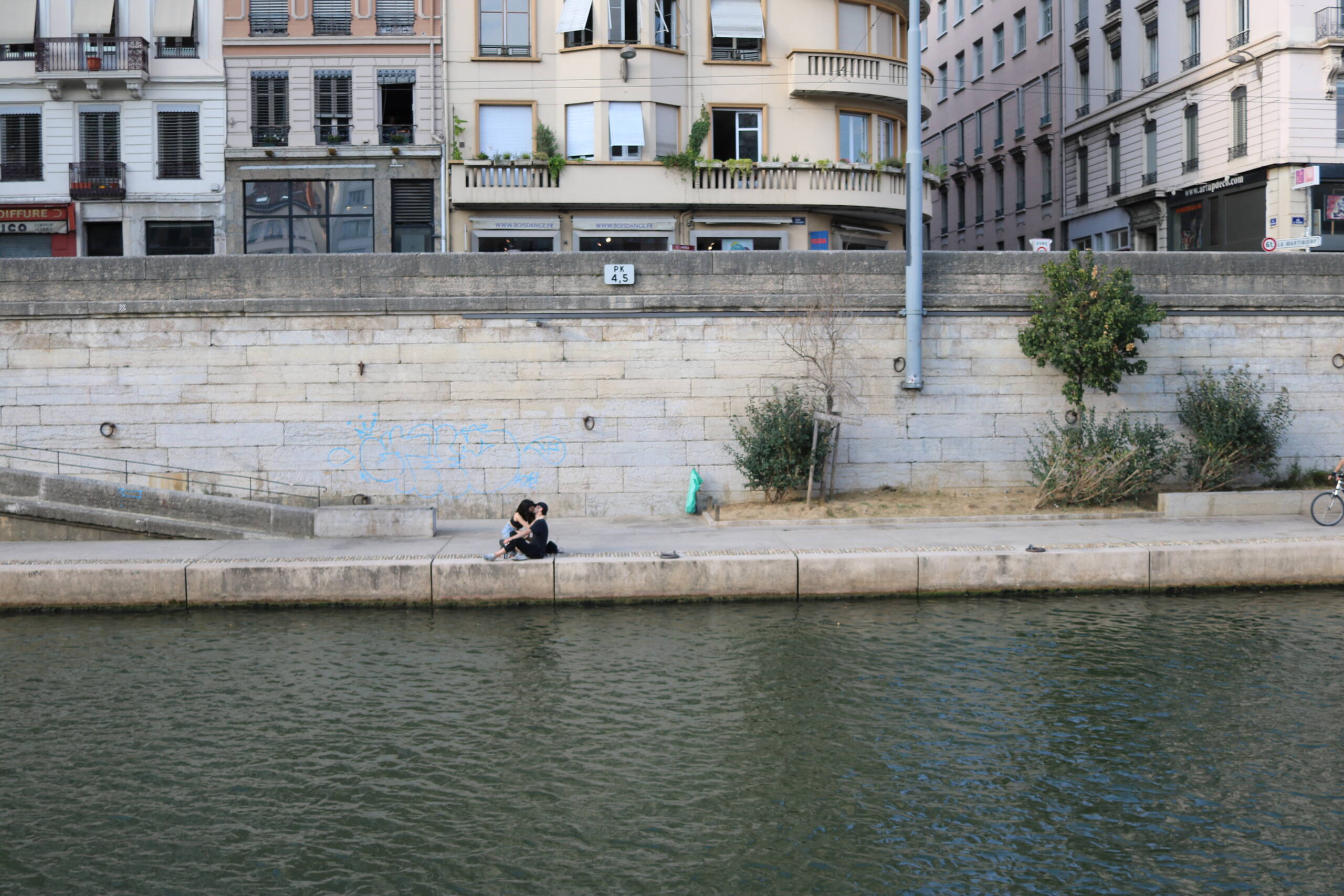
I was on the far bank. The couple were not the reason I raised the camera. The wall was. Courses of pale ashlar running the full width, a dark horizontal service rail cutting across it, the kilometre marker set into the stone like a museum label nobody reads. It’s a good wall. It is also completely dead as a photograph on its own, because there’s nothing in it to tell you how big it is or why you should care.
Then two people walked down and sat.
Scale is a job, not a bonus
A figure in a landscape frame does one specific piece of work: it converts abstract texture into measurable space. Before they sat down, the stone courses could have been forty centimetres tall or four metres. After, you know instantly. Your eye finds the human, sizes it, and back-solves everything else in the frame against it.
That’s a job. And like any job, you should hire the smallest worker who can do it. The temptation is to make the figure bigger so it “reads” better. Bigger figure means the viewer starts looking at the people instead of measuring with them, and the moment that happens you’ve lost the wall, which was the subject.
Rule I keep coming back to: if you can see the person’s expression, they’ve stopped being scale and started being the story. Decide which one you want before you frame, not after.
Give them something to sit against
Small figures die against busy backgrounds. This one survives because two things are true at once.
They’re dark on pale. Both of them in black, against limestone in late sun. That contrast is doing more work than any amount of sharpness at that distance. If they’d been in beige they’d have vanished and there would be no photograph.
And they’re sitting at a junction. The lower quay edge, the shadow line at the base of the wall, and the step block behind them all converge near where they are. The eye travels those horizontals anyway, and it hits them on the way. You don’t need to place a small figure at a thirds intersection. You need to place them where a line the viewer is already following runs out.
Look at where they actually are in the frame: left of centre, low, sitting on the last third of the paved quay before it opens out. There’s empty stone to their right for a long way. That emptiness is not wasted space. It’s the thing that makes them look small.
The metering will lie to you
Sunlit limestone across a whole frame drags the meter down and hands you a flat grey wall with no texture. On a bright evening like this I’ll sit around a stop under whatever the camera suggests and check the highlights on the top edge of the quay, where the sun is hitting hardest. Protect that edge and the rest falls into place.
The water helps. It’s the darkest large area in the frame and it wants to block up into a flat green sheet. Keeping some ripple detail in the bottom third gives the picture a floor. If the water goes to mud, the whole thing tips forward.
Wait, then don’t crop
The two useful habits here are opposite in feeling and identical in effect.
Wait. The frame existed before the couple did. I’d already worked out where I was standing, what focal length flattened the wall into a clean band, and where the top edge should cut. Then it was a matter of standing there until somebody entered it. Most of the time nobody does anything interesting and you go home with a wall. Sometimes two people sit down and lean into each other and you get twenty seconds.
Then leave it alone. The crop that pulls in on the couple exists in every one of these files, and it’s always worse. It’s a mediocre picture of two strangers instead of a decent picture of a riverbank. Cropping in on the figure is the digital version of walking closer, and it undoes the only decision in the frame that took any discipline.
There’s a side benefit that’s worth saying out loud. At this distance the couple are unidentifiable. They were having a private moment on a public quay and they stay private in the photograph. Shooting people small isn’t only a compositional choice. It’s the version of street photography where you don’t have to have an argument with yourself afterwards about whether you should have taken it.
My digest:
- Why I Love Visiting Photography Stores
- The Fascinating World of Photography
- Iran's Tanker Strikes Hit a Wartime High on the Omani Side of Hormuz, Aimed at Ships on Its Non-Compliance List
- GENIUS Act Takes Effect by January 18 With Every Stablecoin Rule Still a Proposal
- Apple's US Link-Out Fee Is Zero Until a Judge Sets It, and Apple Is Asking for Up to 15%
- Idempotency Keys: How One Header Stops a Retry From Charging a Customer Twice
- Conference Keynotes Are Theatre: The Attendee List Is the Product
- Temporal KV: A Key-Value Store That Remembers History
- Mobile App Performance: The Five Metrics That Decide Retention and Store Ratings
- Counterfactual Store: A Database That Stores Alternatives, Not Just Facts