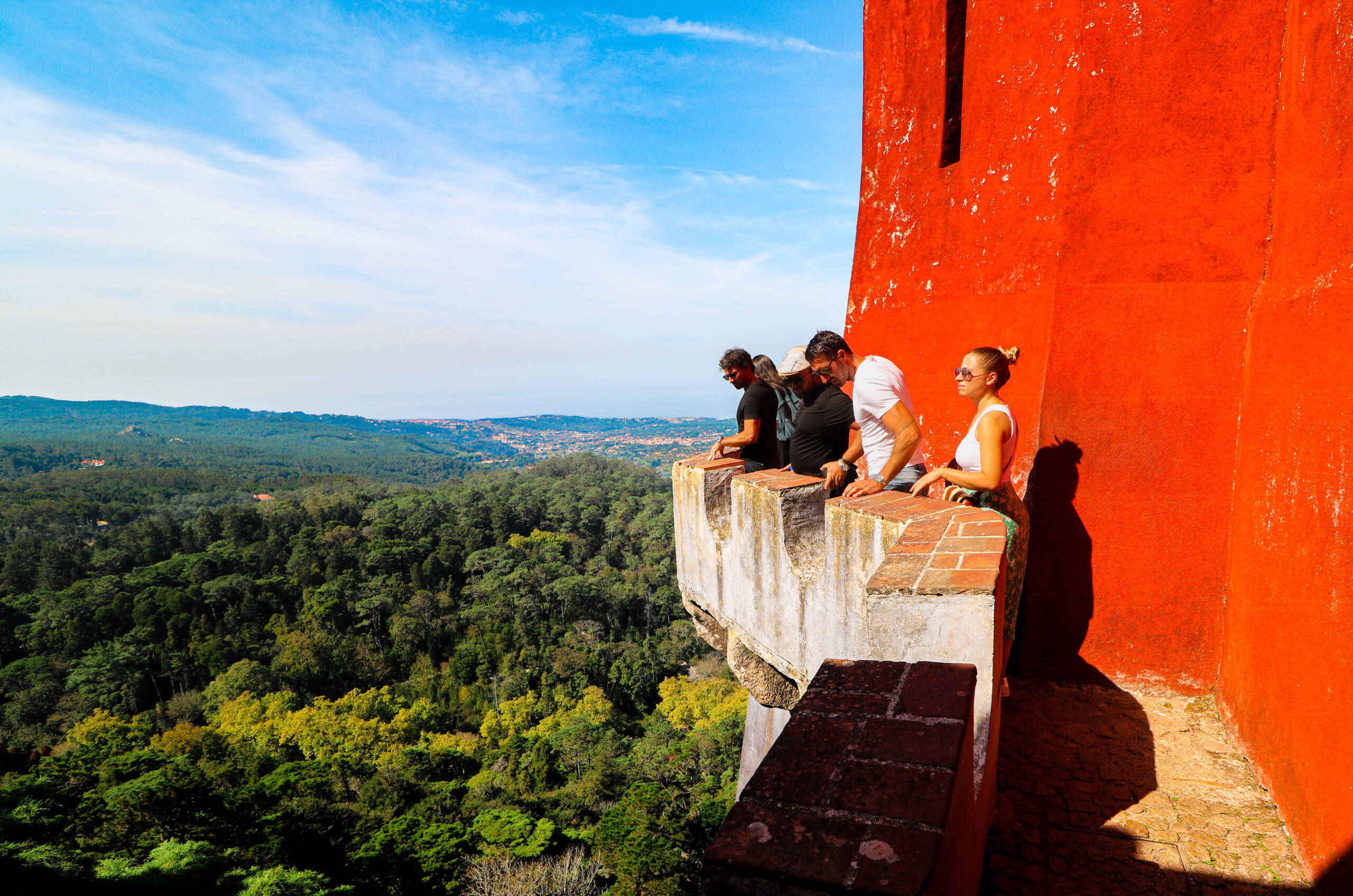
Pena Palace sits on top of the Sintra hills with its walls painted in flat blocks of red and yellow. This frame is from one of the terraces. The red rendered wall fills the right third and stops on a hard vertical edge. To the left, five visitors lean on a crenellated parapet with their backs to the camera, looking out over the forest toward the coastal plain. The sun is almost straight overhead.
Most people arrive at Pena at the worst time for photography, in the middle of the day, along with everyone else. That’s usually how it goes on a day trip from Lisbon. The good news is that the palace is built for bright light. The bad news is that your camera’s red channel isn’t.
Watch the Red Channel
Saturated red in hard sun clips before the standard histogram tells you anything’s wrong. The luminance graph looks fine, and the wall turns into a flat red slab with no texture in it. Switch the histogram to RGB view and watch the red channel on its own. Pull exposure down until it comes off the right edge, even if the sky and the stone then look a little dark. Shadows lift easily from a raw file. Clipped red doesn’t come back.
Picture styles matter here too if you shoot JPEG. A vivid or landscape style pushes saturation further and makes the clipping worse. Standard or neutral gives you more room.
Use the Wall as a Colour Field
The composition in this frame works because the red isn’t treated as background. It’s a solid block that cuts the image in two. Put the edge of the wall on a third line and keep it truly vertical, which means holding the camera level and not tilting up at the towers. A standard zoom around 35 to 50mm (full-frame equivalent) keeps the wall from bending and leaves enough of the view to read as distance.
Let the Crowd Work for You
You won’t get the terraces empty at midday, so stop trying. Wait for a group to line up along the parapet facing out. Backs of heads give scale, point the viewer at the view, and don’t raise any of the problems a crowd of faces does. Five people in a row reads as a composition. Twenty people milling around reads as a queue.
Check the weather in Sintra itself before you go, and don’t rely on the forecast for Lisbon. The hills often sit in cloud while the city below is sunny. Fog on the terraces gives you a completely different picture, soft and grey with the colours muted, and it can clear in minutes. Tickets for the palace come with an entry time, so book ahead in high season and plan the terraces around it.