Vincent van Gogh has a new auction record. His 1890 painting Châtaigniers en fleurs, better known as Blossoming Chestnut Trees, sold for $190.4 million including fees at Sotheby’s in New York on Wednesday, November 18, 2026. The result surpassed every previous public auction price for the Dutch painter and put the picture among the four most expensive paintings ever sold at auction. For a scene of a road and some trees, that is a remarkable number. But the painting itself deserves a longer look than the price tag.
Van Gogh painted the work in Auvers-sur-Oise, north of Paris, during the last months of his life. The setting is ordinary enough: a village street, houses on the left, pedestrians under the trees, and an avenue that bends away from the viewer. Yet the scene seems almost electrically alive. The chestnut branches press down over the road, turning a pleasant walk into a tunnel of moving greens, dark shadows and flashes of yellow. There is very little empty sky. Nature occupies nearly the whole canvas.
The eye first finds the broad, pale roadway, then the cluster of figures beneath the trees. One person approaches from the lower left while others gather in the middle distance, their clothes picked out in muted reds, yellows and blues. White walls and warm brown wooden frontage anchor the village on the left, but the houses quickly lose their importance beside the trees. Van Gogh builds those trees from restless, directional strokes: deep emerald and blue-green masses crossed with ochre and gold, as though the foliage were vibrating in the light.
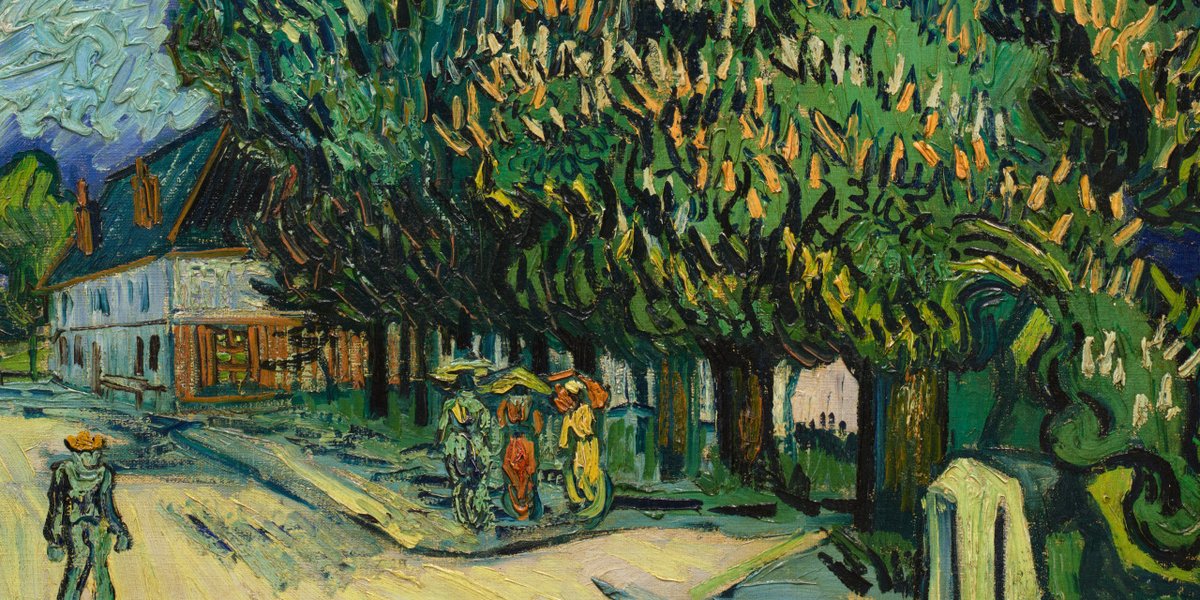
What makes the composition compelling is the imbalance between its calm subject and its energetic surface. The road invites a stroll, while the tree crowns seem to surge and twist overhead. Branches become near-black calligraphic lines, and individual leaves are suggested with small streaks of yellow rather than carefully drawn. Even the figures feel absorbed into the landscape. It is possible to see the whole picture as an image of a peaceful French village, then look again and find something much more urgent. That’s the trick of Van Gogh at his best.
The $190.4 million result easily passed the painter’s previous auction high of $117.2 million, achieved by Orchard with Cypresses at Christie’s in November 2022. It was also an unusually conspicuous sale for a work long held privately. The Blaquier-Arrieta family had owned the picture since 1975. Buyers at this level are paying for more than brushwork: scarcity, provenance, the importance of the artist’s final period and the chance to possess a painting that museums and collectors have studied for generations all feed into the price.
There is a more difficult part of the painting’s history. The German Jewish publisher Samuel Fischer acquired it in 1909, and his family sold it in 1936, during the Nazi period. Fischer’s descendants questioned the circumstances of that sale, arguing that persecution and economic pressure had played a role. Before this week’s auction, Sotheby’s announced an agreement between the heirs and the family selling the painting. The agreement cleared the way for the sale, but the provenance matters just as much as the bidding record when understanding why this work drew attention.
At $190.4 million, Blossoming Chestnut Trees has become a headline about the upper limits of the art market. In the image, though, the most interesting thing still costs nothing to notice: how a quiet street can be made to feel turbulent through color, scale and the insistence of a painter’s hand. The auction confirmed the painting’s market importance. Its visual power was already there.