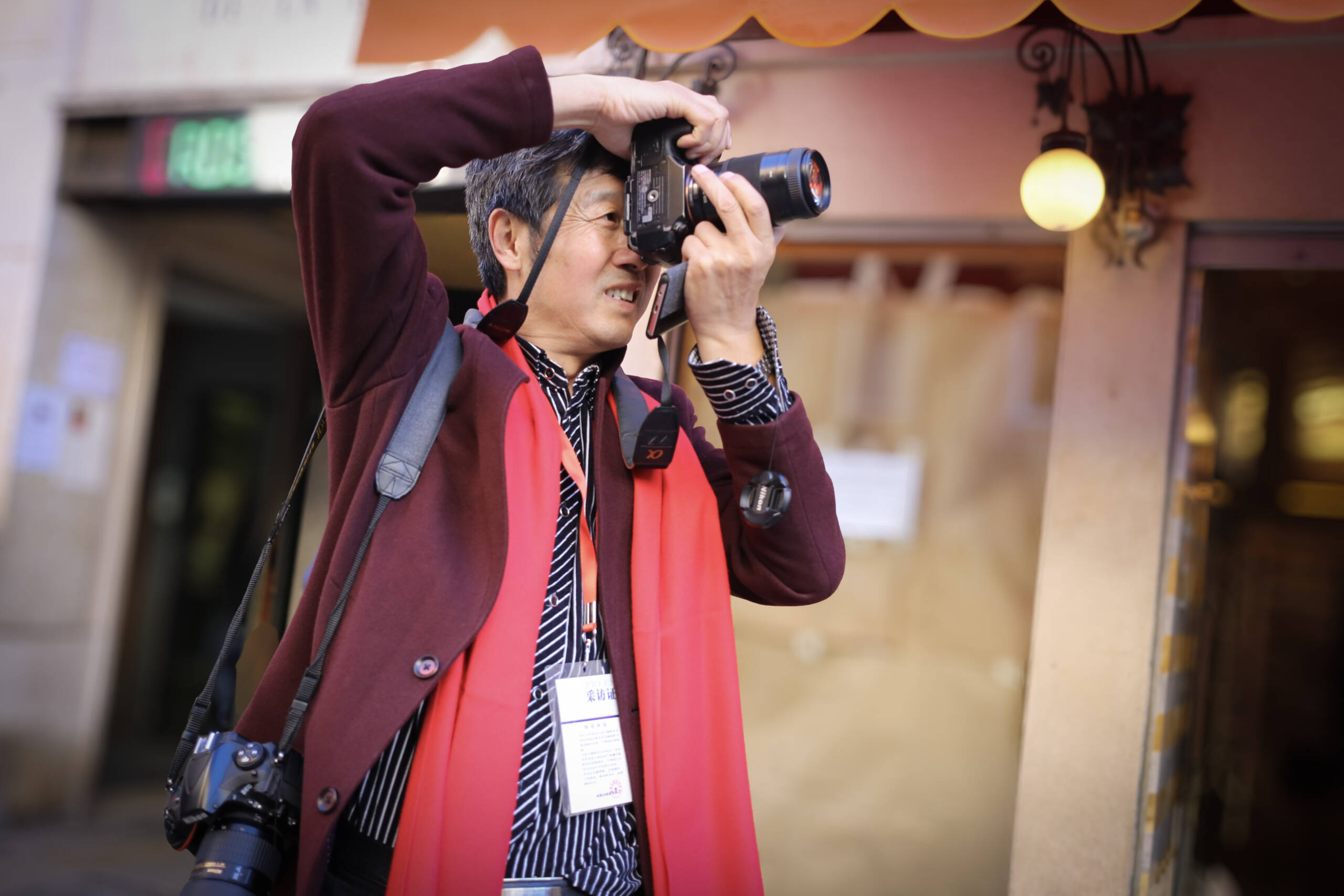
An older photographer in a burgundy wool coat and bright red scarf shoots a Nikon DSLR at eye level. His phone is still in the same hand, pressed against the camera body. A second DSLR with a long zoom hangs at his hip, a Nikon lens cap dangles from a keeper leash, and a Chinese-language press credential hangs from a lanyard around his neck. Behind him there’s an orange scalloped awning and a wall lamp, rendered soft by a long lens and shallow depth of field.
Why Photographers Make Good Subjects
At any event with media access, the working photographers are some of the most interesting people in the room to photograph. They’re concentrating, so they stop performing for anyone else. Their kit tells a story on its own. And they move with purpose, which gives you gesture and body shape without having to ask for it.
Everything in this frame says what kind of job he’s doing. Two bodies means no time for lens changes. The phone in the shooting hand means pictures are being sent as the event goes on. The lens cap on a leash means someone who’s lost enough lens caps to fix the problem for good. The credential shows where he’s allowed to stand.
How to Get the Shot
Use a long lens from a distance. An 85mm or longer on full frame, or a mid-telephoto on a crop body, lets you work from outside his space, and it compresses the background into colour. Open the aperture wide enough to separate him from the awning while keeping the camera and his hands sharp. Focus on the eye nearest the camera if you can see it, or on the camera itself if his face is hidden behind it.
Wait for the moment he’s actually shooting. Photographers between frames look like anyone else checking a phone. The picture is in the second where the camera is at the eye and the whole body commits to it.
The Etiquette
Photographers notice cameras pointed at them faster than anyone. Don’t hide what you’re doing, and don’t get between a working photographer and their subject for your own frame. A nod afterwards goes a long way, and so does offering to send the picture. Most working photographers have almost no good pictures of themselves at work, and plenty will gladly take one.
Be careful with credentials in published pictures. A badge can show a name, an outlet and an event. Crop or blur a readable name if the person isn’t a public figure and hasn’t agreed to be identified.