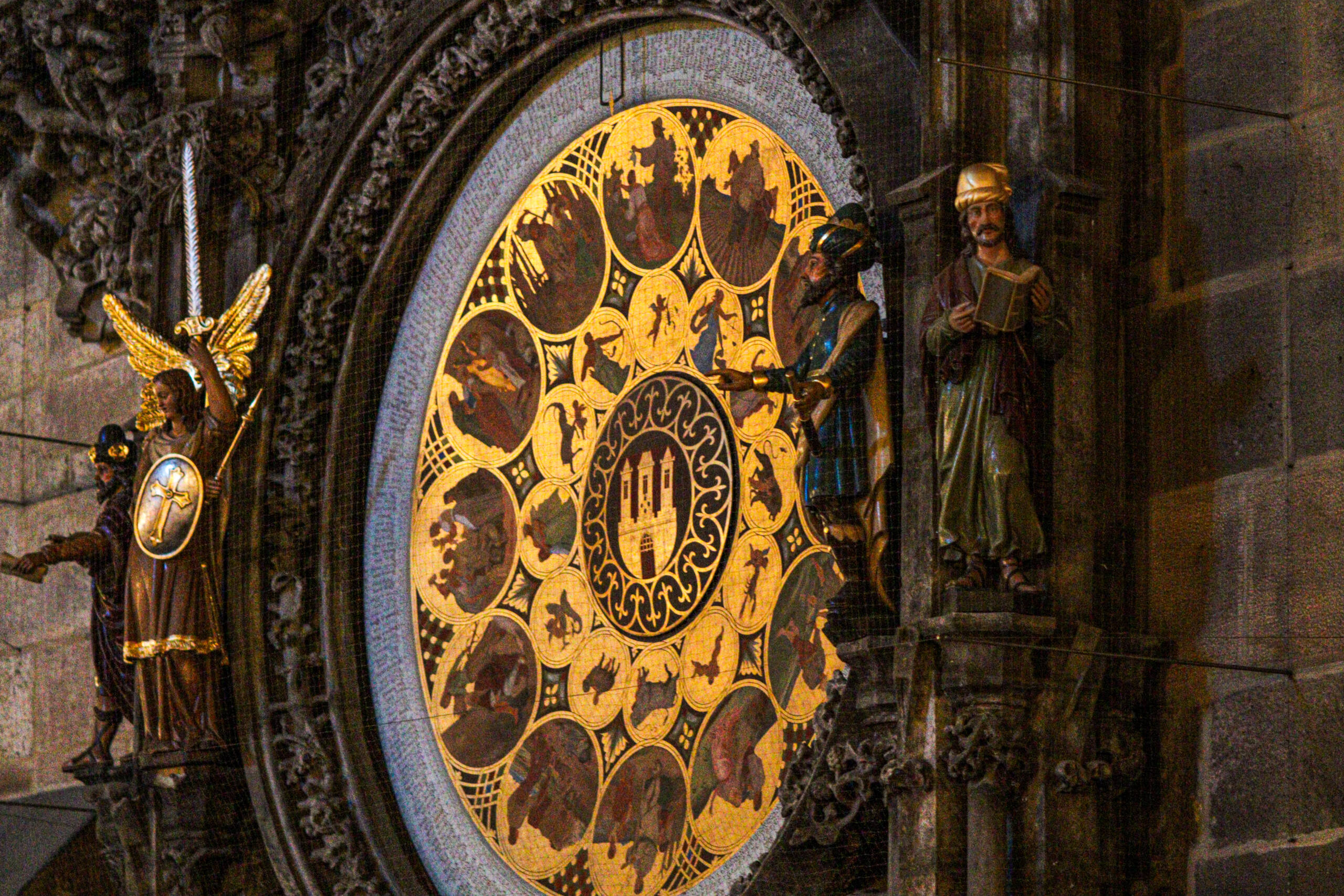
At night the lower dial of the Prague astronomical clock is lit warm against a dark tower. This frame takes in the calendar dial: the month and zodiac medallions around the edge, the Old Town coat of arms at the centre, the archangel with sword and shield standing to the left and the chronicler with his book to the right. Across the whole thing runs a fine mesh of anti-bird netting.
By day the Orloj is one of the most crowded spots in Europe, with hundreds of phones raised for the hourly procession of apostles. Late in the evening the square thins out and the lighting does the work. It’s the better time to photograph the dials.
Meter for the Dial
The lit dial is a small bright object in a mostly dark frame. Evaluative metering will try to brighten the whole scene and blow the gilding. Use spot or centre-weighted metering on the painted medallions, or dial in around one to two stops of negative compensation and check the highlights on the gold. Keep white balance warm, around tungsten or a little above. Correcting the light fully to neutral makes the paintwork look grey and cold.
Shutter speed is usually the limit handheld. Nothing in the scene moves apart from people, so a stabilised body and a slow shutter will do. Raising ISO is fine too. The dial has plenty of fine detail, but noise in the dark stone around it hardly matters.
Living With the Netting
The netting can’t be removed and sits too close to the dial to throw out of focus. Three things help. Shoot as close to straight on as the lane allows, since an oblique angle stacks the mesh lines and makes them more visible. Step back and use a longer focal length, which flattens the netting against the surface behind it. Go easy on sharpening in editing, because the fine grid is exactly what sharpening grabs, and it’ll outline every strand in a halo.
Watch for moiré as well. A regular mesh photographed on a regular sensor grid can produce wavy interference patterns at some distances and focal lengths. If you see bands on the rear screen, change focal length slightly or move a step and shoot again.
A Copy Worth Photographing
The calendar painting on the dial is a copy. Josef Mánes’s original is kept in the City of Prague Museum, and the version on the tower has been replaced more than once. None of that makes it less worth the frame. Just know that a close crop of the medallions is a photograph of a reproduction, and caption it honestly if you publish it as art.